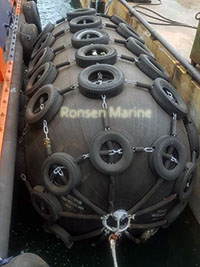
A pneumatic rubber fender works by compressing trapped compressed air inside a reinforced rubber cylinder to convert a ship’s kinetic berthing energy into increased internal air pressure and elastic rubber deformation. Because air is highly compressible, the fender absorbs large impact energy while returning a very low reaction force to the hull—then rebounds to its original shape when the load is removed.
Also called Yokohama fenders or floating pneumatic fenders, they are the global standard for ship-to-ship (STS) transfer and floating berths under ISO 17357-1:2014.
What Is a Pneumatic Rubber Fender?
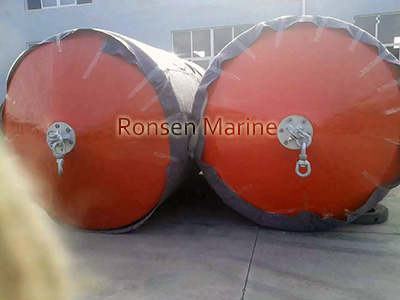
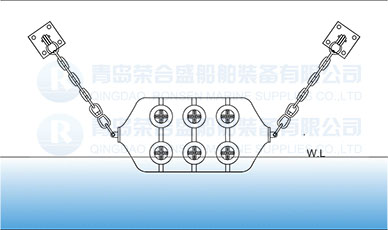
A pneumatic rubber fender is a hollow, cylindrical, air-filled marine buffer built from synthetic-tire-cord-reinforced rubber layers with hemispherical ends. It floats at the waterline, tethered by slings or a chain-tire net, and rises/falls with tide and swell without fixed mounting.
Pneumatic Fenders
Key identifiers:
Internal medium: compressed air (initial 50 kPa = P50, or 80 kPa = P80)
Body: outer rubber + synthetic cord reinforcement + inner air seal
Performance basis: 60% diameter deflection at Guaranteed Energy Absorption (GEA)
The cord layer is the “skeleton”—same principle as a truck tire. Without it, the rubber would balloon and fail.
Sling Pneumatic Fenders
How Pneumatic Fenders Absorb Energy (Step by Step)
Vessel approaches → fender floats at hull contact point.
Hull presses → fender compresses axially up to 60% of original diameter.
Air column shortens → internal pressure rises uniformly (P50 or P80 baseline + impact spike).
Kinetic energy converts → E = \frac{1}{2}mv^2 becomes internal air pressure + rubber/cord elastic strain.
Reaction force stays low → because air compresses progressively, hull sees soft cushioning, not a hard wall.
Vessel retreats → air re-expands, rubber rebounds elastically, fender ready for next hit (no break-in cycle needed, unlike solid rubber).
Under ISO 17357 parallel compression test, EA is the integral of reaction force over deflection:
a = \int R(x)\,dx , measured to 60% deflection at ≤80 mm/min.
Why Reaction Force Stays Low (The Core Advantage)
Solid rubber fenders fight the hull with material stiffness. Pneumatic fenders fight with gas compressibility.
Air has no fixed shape and no high initial modulus—so the force-deflection curve rises gently at first, then steeper near 60%. That “soft entry” is why pneumatic fenders show:
High EA (e.g. Ø3300×6500 mm P80 ≈ 3015 kJ at GEA)
Low hull pressure (P50 often 130–150 kN/m² class)
Minimal structural stress on LNG, VLCC, and thin-shell hulls
P50 vs P80: Tuning by Air Pressure
You do not change the size—you change the initial inflation pressure.
Ship-to-ship transfer (crude, LNG, product tankers)
Offshore platform / FPSO boat landing
Tidal jetties and ferry terminals
Naval alongside replenishment
Emergency berthing where no fixed fender exists
Sizing Reminder (So the Physics Matches the Berth)
Select by design berthing energy, not boat length:
Vessel displacement + approach velocity
PIANC WG-211 energy model
ISO 17357 GEA at 60% deflection
Hull allowable pressure → pick P50 or P80
Check reaction force against dolphin/wharf limit
A 2000×3500 mm P50 fender ≈ 875 kJ EA / 128 kN/m² hull pressure—then you verify RF fits the structure.
FAQ
How does a pneumatic fender absorb energy without solid foam?
It compresses sealed air inside a cord-reinforced rubber body; the air pressure rise plus rubber elasticity stores the vessel’s kinetic energy and releases it on rebound.
What is the difference between P50 and P80 pneumatic fenders?
P50 is inflated to 50 kPa initial pressure, P80 to 80 kPa. P80 gives 30–50% more energy absorption but higher reaction force on the hull.
Do pneumatic fenders need maintenance?
Yes—regular air-pressure checks (cold/warm drift), valve inspection, and net/sling wear checks. Foam fenders do not.
Can a pneumatic fender explode?
Not under normal use; ISO units ≥2.5 m carry automatic safety relief valves. Burst risk comes from over-inflation, fire, or ignored valve failure.
Why are they called Yokohama fenders?
The Yokohama Rubber Co. commercialized the floating air-filled design in the 1950s; “Yokohama-type” is now synonymous with pneumatic rubber fender.
A foam fender works by converting a ship’s kinetic berthing energy into reversible compression of a closed-cell foam core wrapped in a tough elastomer skin. There is no compressed air inside—so the fender cannot deflate, keeps floating after skin damage, and needs no pressure maintenance.
When a vessel presses against it, the closed-cell EVA or polyethylene foam compresses (typically rated to 60% deflection), the reaction force rises progressively, and the hull slows down. Once the vessel moves away, the foam rebounds elastically and is ready for the next impact.
That is the whole mechanism in one paragraph.
The 3-Layer Structure of a Foam-Filled Fender
Every foam fender (also called foam-filled fender or floating foam fender) uses the same functional stack:
1. Closed-Cell Foam Core
Foam Fender
Made of cross-linked PE or EVA foam, thermally laminated into one solid body. Each cell is sealed independently.
Absorbs energy by cell compression + polymer shear
Water cannot enter even if the skin is cut
Density (~58–70 kg/m³) sets the energy/reaction balance
2. Filament Reinforcement Layer
A helical nylon or Kevlar cord layer sits between foam and skin to stop the coating from peeling under repeated shear—critical for STS and offshore use.
3. Polyurethane / Polyurea Elastomer Skin
Sprayed seamless outer shell (Shore A 75–95, tear >52 N/mm, −40 °C to +60 °C).
Resists UV, saltwater, oil, abrasion
Optional non-marking grade for cruise/yacht hulls
Internal swivel eyes or a center tension chain take the hanging load; the foam itself only takes compression.
The Energy Absorption Mechanism (Physics)
A berthing ship arrives with kinetic energy:
E = \frac{1}{2}mv^2
The fender dissipates that energy in four steps:
Hull contacts fender → local pressure rises
Closed-cell foam cells compress and shear
Micro gas pockets in cells add pneumatic-like cushioning without air chambers
Vessel decelerates; energy is stored elastically, then released as the foam rebounds to ≥90% of original diameter within 24 h
Unlike a pneumatic fender, performance does not drift with temperature or altitude, because there is no gas law involved—only foam modulus and geometry.
In a pneumatic fender, one valve or skin failure = total pressure loss.
In a foam fender, the buoyant medium is the solid foam itself. Cut the skin, and each closed cell stays dry and buoyant. The unit keeps cushioning until you patch or re-skin it.
That is why naval bases, LNG terminals, FPSO boat landings, and remote jetties specify foam-filled units.
Where Foam Fenders Are Used
Quay and jetty berthing (vertical hung, chain sling)
Ship-to-ship transfer (LNG, crude, product tankers)
Allowable hull pressure (PIANC WG-211: usually <200 kN/m²)
Design energy per PIANC/ASTM F2192
EA and RF at 60% deflection from the maker’s curve
Example: a 1000 × 1500 mm foam fender is commonly ~49 kJ absorption at ~205 kN reaction at 60% deflection—then you check that RF against your hull and dolphin limit.
FAQ
How does a foam fender absorb energy without air?
It compresses a closed-cell foam core; the polymer matrix and sealed cells store elastic energy, so no internal air pressure is needed.
Do foam fenders bounce a ship back?
They rebound elastically (≥90% diameter recovery in 24 h), but with less liveliness than pneumatic fenders—better for fixed structures, less ideal for high-angle STS roll.
What happens if a foam fender is punctured?
Nothing catastrophic: the skin can be patched, the core stays buoyant, and the fender keeps working until repaired.
Are foam fenders better than pneumatic fenders?
For unattended, debris-heavy, or offshore sites—yes. For temporary STS with strict low reaction force—pneumatic is often better.
How long do foam fenders last?
Quality PU/polyurea-skin units run 10–20 years; cores can be re-skinned to extend life.
A general surface support buoy works by displacing water with a permanently buoyant closed-cell polyethylene (PE) or EVA foam core to support the submerged weight of mooring chains, ropes, hoses, or cables—while an internal steel frame carries the tensile load and a polyurethane skin resists the marine environment. There is no air chamber to inflate or lose, so the buoy cannot sink even if the skin is cut.
In short: it is not an energy absorber like a fender—it is a floating load-relief block that keeps mooring lines partially suspended, reduces seabed drag, and acts as a shock buffer (“self-fendering”) when hulls or chains slap against it.
What Is a General Surface Support Buoy?
A general surface support buoy (sometimes written “general surface foam buoy”) is a cylindrical or chain-through floating body used in:
Single-point mooring (SPM) systems
Mid-line chain support for tanker moorings
Subsea cable and flexible hose lay operations
Pick-up / messenger buoys for offshore transfer
Dredge pipe and discharge hose support
General Surface Support Buoys
Three common subtypes:
Cylindrical Buoy (CB) – central tension member or clevis eyes, chain attached externally
Chain-Through Buoy (CTB) – central tube lets the mooring chain pass through and lock at one/both ends
Pick-Up Buoy (PU) – smaller unit for marker / messenger / mooring pickup duties
The 3-Part Structure That Makes It Work
LayerMaterialFunctionFlotation coreThermo-laminated closed-cell PE or EVA foamPermanent buoyancy; cells stay dry if skin is breachedInternal steelworkCentral tube, gussets, load flanges (hot-dip galvanized / epoxy)Takes tensile/working load; foam never sees pure tensionOuter skinSprayed polyurethane (PU) or polyurea elastomer, often nylon-filament reinforcedAbrasion, UV, seawater, marine-growth resistance
The foam is cross-linked and thermo-laminated around the steel mandrel so the two act as one monolithic block. Because the steel carries the chain tension and the foam only carries compression/buoyancy, the core will not tear under mooring load.
The Working Principle, Step by Step
Archimedes does the work – the closed-cell foam core displaces a volume of water heavier than the buoy’s own weight plus the submerged weight it must lift. Net upward force = buoyancy reserve (freeboard control).
Chain/rope is partially supported – in an SPM midline, the buoy suspends a portion of the chain’s submerged weight, reducing ground chain drag and improving catenary behavior.
Steelwork takes the load – SWL (safe working load) is set by the central tube and end flanges, not the foam. The foam is there for displacement, not strength.
Self-fendering on impact – when a hull, chain, or tug brushes the buoy, the resilient foam core compresses locally and rebounds. This is secondary behavior (unlike a foam fender’s primary EA role), but it removes the need for separate rubbing strips.
Damage does not sink it – cut the PU skin and seawater hits closed cells; each cell is sealed, so no water ingress, no loss of displacement, no deflation event.
Tide/swell tracking – because it floats by solid displacement, it rises and falls with water level, keeping the chain geometry stable without powered adjustment.
Buoyancy Sizing Logic (Why It’s Not Like a Fender)
You do not size a support buoy by berthing energy. You size it by:
Both share the closed-cell foam + PU skin recipe, which is why vendors often cross-sell them—but the hydrodynamic role is opposite.
Why “Unsinkable” Holds Up
Air-filled buoys lose displacement the moment the envelope leaks. A general surface support buoy’s displacement comes from solid polymer foam whose cells are already gas-filled at manufacture and sealed. Puncture the skin → cells stay dry → displacement unchanged → buoy stays at the surface until you re-skin it. That is why OCIMF-style SPM specs and PIANC buoyancy guidance favor foam-core units for unattended offshore lines.
How does a surface support buoy float without air?
Its closed-cell PE/EVA foam core displaces seawater permanently; the gas inside each foam cell is sealed at manufacture, so no inflation and no deflation path exists.
Is a support buoy the same as a fender?
No. A support buoy carries mooring-line weight and provides flotation; a fender absorbs berthing impact energy. Support buoys are “self-fendering” only as a side benefit.
What happens if the PU skin is torn?
Nothing structurally critical—closed cells block water entry, buoyancy holds, and the unit stays in service until patched or re-skinned.
How long do general surface support buoys last?
10–15 years typical in offshore service with annual skin/steelwork inspection; tropical UV and ice zones shorten skin life but not core buoyancy.
How do you calculate the right buoy size?
Sum the submerged weight of the chain/rope/hose segment you want lifted, add freeboard reserve, divide by net lift per m³ of foam core (~9.5 kN/m³ seawater), then match SWL to your central steelwork rating.
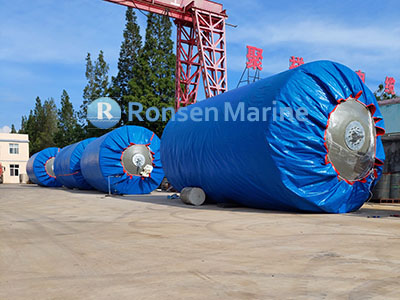
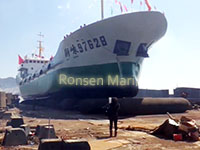
A marine airbag works by inflating a cord-reinforced rubber cylinder with compressed air to lift a vessel off its keel blocks, then acting as a giant roller that carries the ship’s weight on its curved surface while the hull glides down a slipway into the water. The ship’s static weight is balanced by internal air pressure (typically 0.05–0.20 MPa working pressure); the synthetic tire-cord layers stop the rubber from bursting; and the cylindrical shape turns linear motion into smooth rolling contact.
Also called ship launching airbags or rubber roller bags, they are governed by ISO 14409:2011 (construction/testing) and ISO 17682:2013 (launch methodology)—and they are not pneumatic fenders, even though both are air-filled rubber.
What Is a Marine (Ship Launching) Airbag?
A marine airbag is a heavy-duty, inflatable, cylindrical device with tapered/conical ends, placed perpendicular or longitudinal under a hull to support and roll vessels. Typical specs:
Diameter: 0.8–3.0 m (most common 1.0–2.5 m)
Effective length: 6–25 m
Cord plies: 4–12 layers
Working pressure: 0.05–0.20 MPa (varies with Ø and ply count)
Burst safety factor: ≥ 4:1 vs working pressure (leading makers ≥ 5:1)
Standards: ISO 14409:2011, ISO 17682:2013; class endorsements CCS/ABS/BV/DNV/LR
The 3-Layer Composite Structure
Same family as a pneumatic fender, but optimized for rolling contact and static load, not impact EA.
LayerMaterialFunctionInner rubberNR/SBR/IIR airtight blendSeals compressed air, resists fatigueCord reinforcementCrisscrossed nylon/polyester tire cord (2- or 3-strand), RFL-bondedCarries hoop stress from internal pressure, prevents burstOuter rubberAbrasion-/UV-/salt-resistant NR compoundProtects cords on rough slipways, low-friction rolling surface
End fittings: steel flange + ball valve + pressure gauge + safety relief valve. The cord angle and ply count decide the max working pressure, not the outer rubber thickness.
The Working Principle, Step by Step
Place deflated bags – laid longitudinally (end-launch) or transverse (side-launch) under the hull between keel blocks, spaced so unsupported hull span stays within plate/keel stress limits.
Inflate to working pressure – compressor fills bags to 0.08–0.12 MPa (mid-size). Internal pressure × contact footprint lifts the hull off the blocks.
Lift height ≈ pressure-based squash; e.g. a 1.5 m Ø bag at 0.10 MPa supports ~12 t/m line load.
Remove keel blocks – hull now rests entirely on the airbags’ top arc. Load is distributed continuously, no hard chocks.
Release holding winch – gravity (on 1:70 to 1:20 slope) or tug/winch pulls the ship. The bags rotate under the keel like conveyor rollers, so the hull rolls instead of slides. Rolling friction is far lower than greased wooden ways.
Stern picks up buoyancy – as the aft enters water, hydrostatic lift takes over part of the weight; forward bags shed load progressively.
Deflate and recover – bags roll out, get deflated, rinsed, powdered, and stored for the next cycle (6–15 yr service life).
The physics in one line
Static equilibrium: vessel weight per unit length ≤ internal pressure × contact width × safety factor, with cord plies setting the pressure ceiling. No kinetic-energy integral like a fender—this is a quasi-static load path, not an impact curve.
Why Cord Ply Count Matters More Than Diameter
A 2.0 m Ø bag at 4 plies might cap at 0.07 MPa; the same Ø at 8 plies runs 0.13–0.15 MPa. Doubling plies roughly doubles allowable pressure (hence line load), which is how yards launch 5,000 t+ hulls without giant diameters.
Selection math (simplified):
Total launch weight − buoyancy gain = weight on bags
Bags needed = total weight on bags ÷ (working pressure × contact width × safety margin)
Then check hull span between bags against plate/keel bending limits—this, not bag capacity, is usually the real constraint.
Marine Airbag vs Pneumatic Fender (The Confusion Google Sees)
AspectMarine launching airbagPneumatic rubber fenderStandardISO 14409 / ISO 17682ISO 17357-1Primary jobLift + roll vessel (static/dead load)Absorb berthing kinetic energyLoad typeQuasi-static hull weightDynamic impact, 60% deflection EAShapeCylinder + conical ends, valve at endCylinder + hemispherical ends, swivel eyesPressure0.05–0.20 MPa working50 kPa (P50) / 80 kPa (P80) initialFailure modeBurst under sustained overloadPuncture/deflation under impactUse caseSlipway launch, haul-out, heavy moveQuay/STS cushioning
Using one for the other is unsafe—different reinforcement geometry, different end fittings, different cert.
Pressure-hold test per ISO 14409: ≤5% drop in 1 h at rated pressure
Relief valve mandatory on larger bags
Slipway cleared of sharp objects; ground bearing checked
Cycle log kept; retire on cord fatigue or outer rubber through-wear
Never exceed 4:1 working/burst margin in calc
FAQ
How does a marine airbag support a ship’s weight?
Compressed air inside the bag pushes outward; the cord-reinforced rubber converts that pressure into a vertical reaction force on the hull contact patch. Pressure × contact area = supported load.
Is a marine airbag the same as a pneumatic fender?
No. Airbags lift and roll dead weight under ISO 14409; pneumatic fenders absorb impact energy under ISO 17357. Different shape, cord angle, end fittings, and safety philosophy.
What pressure do ship launching airbags use?
Typically 0.05–0.20 MPa working, depending on diameter and ply count (e.g. 1.5 m Ø / 6-ply ≈ 0.13 MPa; 1.0 m Ø / 4-ply ≈ 0.13 MPa). Burst pressure is ≥4× working.
Can airbags sink a ship if they burst?
A burst under a hull drops local support and can cause hull grounding or keel overstress—not sinking from the bag itself. That is why multi-bag layouts and 4:1 margins are used: one bag failing does not collapse the launch.
How many airbags do I need?
Divide (vessel launch weight − buoyancy gain) by per-bag line load at your working pressure, then space bags so the unsupported hull span stays within class-approved bending limits. Suppliers turn LOA/beam/weight/slope into a calc sheet.
Do airbags work on flat ground?
They need a slope (as low as 1:70 in favorable cases, typically 1:30–1:20) or external winch/tug pull. Truly flat ground with no pull = no launch motion.
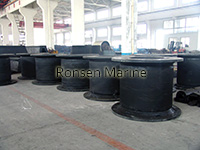
Cell rubber fenders are high-performance compression-type marine rubber fenders installed on quay walls, wharves, and terminal berths to absorb vessel berthing energy and protect both the ship hull and the dock structure. Their name comes from the hollow, cell-like cylindrical rubber body that compresses axially during impact, buckles radially in a controlled way, and rebounds after the vessel departs.
In short: a cell rubber fender is a fixed, heavy-duty dock fender system that turns the kinetic energy of a berthing ship into safe elastic deformation—while keeping reaction force and hull pressure low.
What Is a Cell Rubber Fender (Simple Definition)
A cell rubber fender consists of:
A hollow cylindrical rubber body (the “cell”) with large flanged ends
A steel frontal panel that widens the contact area with the vessel
UHMW-PE face pads that lower friction between hull and panel
Anchor bolts, chains, and mounting hardware fixed to the quay
When a vessel approaches the berth, the rubber cell compresses. The frontal panel spreads the load, the UHMW-PE pad lets the hull slide slightly without gouging, and the rubber absorbs energy instead of transferring a hard shock to the concrete wall or the ship’s side.
How Cell Rubber Fenders Work
Cell Fenders
The working principle is elastic energy absorption:
Berthing impact – A ship carries kinetic energy: E ≈ ½ × M × v² × C (PIANC 2002 method), where M is displacement, v is approach speed, and C is an energy coefficient.
Axial compression – The cylindrical rubber column shortens. Typical rated deflection is 47.5% for standard cell fenders and up to 52.5% for super cell (SC) types.
Radial buckling – The cell wall buckles outward in a controlled pattern, dissipating energy uniformly in all directions.
Low reaction transfer – Because the frontal panel is large, hull pressure stays low (often <50 kPa or <25 t/m² on request).
Recovery – After the vessel leaves, the rubber returns close to its original shape and is ready for the next berthing.
A: Cell rubber fenders are used on docks and quays to absorb the kinetic energy of berthing ships, reduce reaction force on the quay, and lower hull pressure on vessels.
Q: What is the difference between cell and super cell fender?
A: A super cell (SC) fender achieves about 52.5% deflection and roughly 15% better E/R.H efficiency than a standard cell fender, while keeping the same bolt layout for easy replacement.
Q: Are cell rubber fenders better than pneumatic fenders?
A: They serve different roles. Cell fenders are fixed berth infrastructure for permanent daily protection; pneumatic (Yokohama-type) fenders are floating, portable units for ship-to-ship or temporary use.
Q: What standard covers cell rubber fender performance?
A: Performance is usually tested and reported under ISO 17357, with design guidance from PIANC 2002 MarCom WG33.
When safety, durability, and low maintenance are top priorities, shipowners and port authorities turn to one solution: the foam filled fender. Also known as a solid polyurethane fender or EVA foam fender, this technology represents a major leap forward from traditional inflatable systems. But what exactly is it, and why is it considered “unsinkable”?
This guide covers everything you need to know, from construction and working principles to technical specifications and real-world applications.
What Is a Foam Filled Fender?
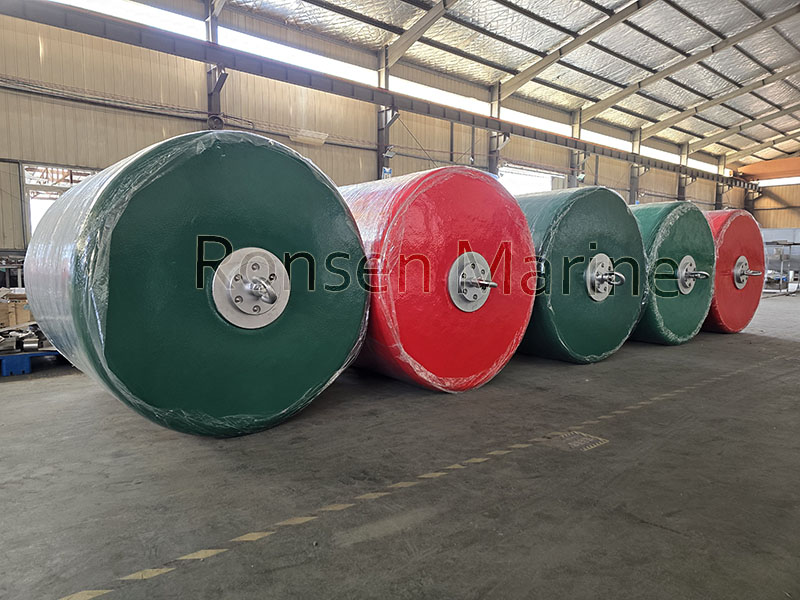
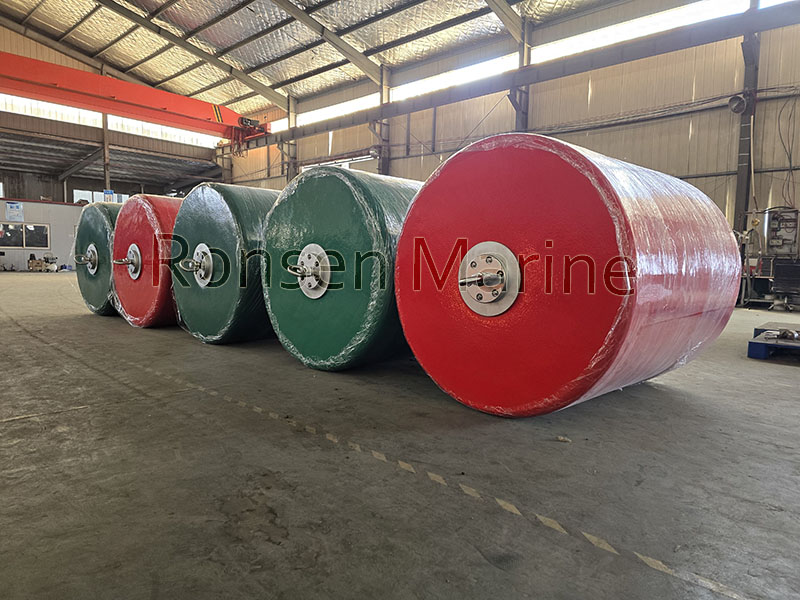
A foam filled fender is a type of solid, floating marine fender that uses a closed-cell foam core as its energy absorption medium. Unlike pneumatic fenders that rely on compressed air, foam fenders are built around a core of expanded polyethylene (EVA) or polyurethane foam, encapsulated within a tough, reinforced polyurethane (PU) elastomer skin.
Because the core is 100% closed-cell, it is impossible for the fender to sink, even if the outer skin is punctured. This makes it the preferred choice for mission-critical operations, including naval defense, offshore oil platforms, and high-traffic commercial ports.
Construction & Working Principle
The Core: High-Density Closed-Cell Foam
The heart of the fender is its closed-cell EVA foam core. This material acts like a highly resilient sponge. Upon impact, the foam compresses, converting the kinetic energy of a berthing vessel into internal energy. Once the pressure subsides, the foam instantly rebounds to its original shape.
Key Advantage: Even if the skin is compromised, the closed cells prevent water ingress, ensuring the fender remains buoyant and functional.
The Skin: Reinforced Polyurethane Elastomer
The core is protected by a thick layer of polyurethane (PU) or polyurea elastomer. This skin is spray-applied using high-pressure equipment, creating a seamless, waterproof barrier.
Reinforcement: A spiral reinforcement layer (often utilizing nylon tire cords) is embedded within the skin to maximize tensile strength and puncture resistance.
Performance: The PU skin offers exceptional resistance to abrasion, seawater corrosion, oil, and ultraviolet (UV) radiation.
How It Absorbs Energy
Foam filled fenders operate on the principle of compressive deformation. When compressed to 60% of its original diameter:
Reaction Force: Increases progressively from low to high, minimizing stress on the vessel hull.
Energy Absorption: Extremely high. Studies show foam fenders can absorb 1.2 to 1.5 times more energy than equivalent-sized pneumatic fenders.
Foam Filled Fender vs. Pneumatic Fender
Buyers often compare these two floating fender types. Here is how they stack up:
Feature
Foam Filled Fender
Pneumatic (Yokohama) Fender
Buoyancy
Unsinkable(Watertight core)
Floats(Risk of sinking if ruptured)
Maintenance
Zero (Maintenance-cree)
Requires regular pressure checks
Damage Response
Puncture does not effect performance
Requires immediate repair
Weight
60%-70% lighter than steel alternatives
Moderate weight
Key Advantages of Foam Filled Fenders
Unsinkable Design: The closed-cell foam core guarantees 100% buoyancy, eliminating the risk of losing equipment at sea.
Maintenance-Free: No valves, no air pressure checks, and no risk of bursting. Install it and forget it.
Extreme Durability: The polyurethane skin is highly resistant to scratches, friction, and impacts from rough berthing.
Weather Resistance: Performs reliably in harsh environments, resisting acid, alkali, and extreme temperatures (-40°C to +70°C).
Lightweight: Weighs significantly less than traditional rubber or steel fenders, simplifying handling and installation.
Customizable: Available in virtually any size and color. Non-marking skins are available for white hulls (e.g., yachts, cruise ships).
Technical Specifications & Classifications
Types of Assembly
Based on external fitting requirements, foam fenders are categorized into three main types:
Sleeve Type: Features a protective chain or rubber sleeve.
Sleeveless Type: Relies solely on the tough PU skin; ideal for clean hulls.
Rotating Ear Type: Equipped with swivel lifting eyes for easy suspension.
Standard Sizes
We offer a full range of standard and custom sizes:
Diameter (D): 0.5m to 3.3m (Custom sizes available up to 4.5m+)
Length (L): 1.0m to 6.5m
Performance: At 60% compression, reaction forces range from 1.5 tons to 160 tons, with energy absorption from 0.18 to 114 ton-meters.
International Certifications
Our foam filled fenders are manufactured under strict quality control and hold certifications from leading international classification societies:
✅ CCS (China Classification Society)
✅ BV (Bureau Veritas)
✅ DNV (Det Norske Veritas)
✅ ABS (American Bureau of Shipping)
Performance in Extreme Conditions
Effect of Temperature
Polyolefin foams are engineered to perform across a wide thermal range.
High Temperatures: In hot climates, foam may slightly soften. We recommend upsizing the fender by 5-10% for installations in extreme heat to compensate for reduced stiffness.
Low Temperatures: In freezing conditions, the foam becomes stiffer, actually increasing its energy absorption capacity without compromising structural integrity.
Effect of Compression Speed
Foam fenders perform exceptionally well under dynamic loads. At high strain rates (fast berthing speeds), the foam core stiffens, allowing it to absorb significantly more energy than during slow, static compression. This ensures reliable protection even during high-speed emergency stops.
Common Applications
Thanks to their robust nature, foam filled fenders are used across the maritime industry:
Naval & Military Berths: Ideal for navy vessels due to their unsinkable nature and low maintenance.
Offshore Oil & Gas: Protecting platforms and tankers in open seas.
Cruise & Ferry Terminals: Non-marking options protect expensive white hulls.
Ship-to-Ship (STS) Transfers: Providing stable cushioning between moving vessels.
Ports & Harbors: General cargo berthing and corner protection.
Ro-Ro & Bulk Carriers: Handling heavy loads and frequent traffic.
FAQ: People Also Ask
Q: Can a foam filled fender really sink?
A: No. The core is made of 100% closed-cell foam. Unlike pneumatic fenders that lose buoyancy if punctured, foam fenders remain afloat and operational even if the outer skin is damaged.
Q: How long do foam filled fenders last?
A: The service life is typically 10 to 15 years. With proper care and suitable environmental conditions, many high-quality foam fenders can last up to 30 years.
Q: Do foam fenders leave black marks on ships?
A: Standard fenders may leave slight marks, but we offer non-marking (white) polyurethane skins specifically designed for cruise ships, yachts, and other vessels with light-colored hulls.
Q: What is the difference between EVA foam and Polyurethane foam?
A: EVA (Ethylene-Vinyl Acetate) foam is generally lighter and offers excellent flexibility and rebound. Polyurethane foam is often denser and can offer higher load-bearing capacity. Both are used in high-performance marine fenders.
Q: Are foam filled fenders heavier than pneumatic ones?
A: They are denser than air-filled fenders but significantly lighter (60-70% lighter) than comparable steel fenders, making them relatively easy to handle with standard port equipment.
Conclusion
A foam filled fender is more than just a bumper—it is a strategic investment in safety and operational efficiency. By combining a 100% closed-cell EVA core with a reinforced polyurethane skin, these fenders offer unmatched durability, zero maintenance, and the peace of mind that comes with an unsinkable design.
Whether you are outfitting a naval base, an offshore platform, or a busy commercial port, foam filled fenders provide the resilient protection your assets deserve.
Ready to specify the right fender for your project?
Contact our marine engineering team today for a free technical consultation, detailed drawings, and a competitive quotation tailored to your specific berthing requirements.
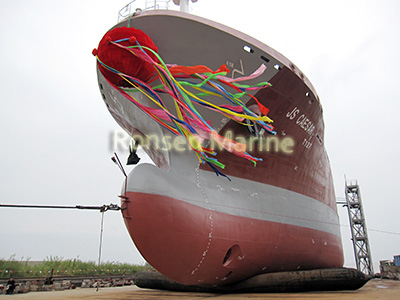
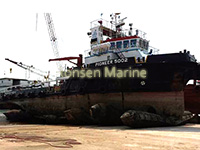
The marine airbag launch ship procedure is a flexible, cost‑effective method of moving a newly built or repaired vessel from the shipyard slipway into the water using inflated cylindrical rubber airbags as rollers. Also known as airbag ship launching or inflatable roller bag launching, this technique replaces traditional dry docks or fixed slipways with portable, reusable marine airbags that bear the ship’s weight and allow it to roll smoothly into the water under controlled speed .
Marine airbags are made of multi‑layer synthetic rubber reinforced with high‑tensile fabric. Once placed under the hull and inflated, they lift the vessel off its keel blocks and act as low‑friction rollers, enabling end‑on or side launching with minimal infrastructure .
Advantages of the Marine Airbag Launching Method
Before diving into the procedure, here’s why shipyards choose airbag launching:
✅ Lower cost – No permanent slipway or dry dock required
✅ Reusable equipment – Airbags can be used for multiple launches
✅ Adaptable – Suitable for small boats to large cargo vessels
✅ Reduced hull stress – Even load distribution and shock absorption
✅ Eco‑friendly – Minimal land alteration and seabed disturbance
Pre‑Launch Preparation (Site & Equipment Checks)
A safe launch begins long before inflation. Key preparatory steps include:
Hull Inspection – Grind down sharp welds, burrs, or protruding fittings on the hull bottom. Close all sea valves, thrusters, and hull openings.
Slipway Preparation – Level the launch path, remove nails, stones, or debris that could puncture airbags. Cross‑slope error should typically be <80 mm for small vessels and <50 mm for larger ones.
Water Depth Check – Ensure sufficient water depth (commonly ≥1.5× the ship’s draft) at the entry point to prevent grounding.
Airbag Selection & Inspection – Choose airbags with adequate diameter, length, and safety factor (typically 1.5–2× vessel weight). Inspect for cracks, leaks, or valve damage.
Rigging & Winch Setup – Install holding winches, wire ropes, pulleys, and ground anchors to control vessel movement. Test compressors and hoses.
Place deflated marine airbags transversely (perpendicular to the launching direction) under the keel at calculated intervals. Spacing depends on vessel length, weight, and airbag load capacity. Extra airbags may be added under heavier mid‑ship sections .
Step 2: Inflate the Airbags & Lift the Hull
Connect air hoses to the compressors. Inflate gradually (typical working pressure 0.03–0.08 MPa / 0.3–0.8 kg/cm² depending on size). As pressure builds, the airbags lift the hull evenly off the wooden keel blocks. Remove all blocks once the hull is fully supported by airbags .
⚠️
Never exceed the airbag’s maximum rated pressure. Use a calibrated pressure gauge throughout.
Step 3: Adjust Pressure & Align the Vessel
Fine‑tune individual airbag pressures to keep the hull level. Misaligned or uneven pressure can cause tilting or airbag damage. Ensure airbags remain perpendicular to the launch path and do not twist during movement .
Step 4: Controlled Rolling Toward the Water
With the holding winch keeping the vessel stationary, release the brake slowly to let the ship roll forward on the inflated airbags. Typical forward speed is 0.5–1 m/s (≈6–13 m/min), controlled by winch tension. Use guide ropes if the vessel tends to veer off course .
Step 5: Final Launch Into the Water
When the hull reaches the water entry point, continue controlled release until buoyancy takes over. For narrow waterways, maintain winch control throughout. For open areas, the final hold‑back wire may be released or cut at the appropriate moment .
Step 6: Deflate, Recover & Inspect
Once afloat:
Slowly deflate airbags (below 0.03 MPa before disconnecting hoses).
Recover airbags from the water, inspect for punctures or deformation.
Clean, dry, and store airbags in a cool, shaded area.
Check the vessel for watertight integrity and measure bow/stern draft .
Key Safety Tips for Airbag Ship Launching
👷 All personnel must wear helmets, life jackets, and anti‑slip footwear.
🚧 Keep non‑essential staff out of the launch zone.
🌬️ Avoid launching in wind speeds above Beaufort Force 6, heavy rain, or rough seas.
🔧 Install pressure relief valves on compressors to prevent over‑inflation.
📋 Conduct a pre‑launch risk assessment and toolbox talk .
FAQ: Common Questions About Marine Airbag Launch Procedure
Q: Can marine airbags be used for any size ship?
A: Yes. With proper calculation of airbag diameter, length, quantity, and safety factor, airbags can launch vessels from small fishing boats to large ocean‑going ships .
Q: What slope is required for an airbag launch slipway?
A: Typical slopes range from 1:7 to 1:15, depending on vessel size and site conditions .
Q: How are airbags arranged under the hull?
A: Common layouts include single‑row linear, staggered, or double‑row arrangements, chosen based on beam width and airbag effective length .
Conclusion
So, what is marine airbag launch ship procedure? It is a systematic, engineer‑led process involving site preparation, calculated airbag placement, controlled inflation, gradual hull lifting, winch‑controlled rolling, and safe water entry—followed by recovery and inspection. When executed with proper planning and safety protocols, marine airbag launching offers shipyards a flexible, economical, and reliable alternative to traditional launching methods.
Foam fender classification refers to the systematic categorization of foam‑filled marine fenders based on their external protection system, geometric shape, energy‑absorption performance, and compliance with international design standards. Also known as foam‑filled fender types or foam fender categories, this classification helps port authorities, marine engineers, and ship operators select the correct fender for specific berthing energies, vessel sizes, and environmental conditions.
A foam‑filled fender typically consists of three layers: a closed‑cell polyethylene (PE) or EVA foam core, a nylon‑filament reinforcement layer, and a polyurethane (PU) or polyurea elastomer skin. Classification focuses primarily on how the outer protection and shape are configured to handle impact, abrasion, and hull pressure.
Why Foam Fender Classification Matters
Choosing the wrong fender type can lead to premature wear, higher lifecycle costs, or even operational downtime. Proper classification ensures:
✅ Correct energy absorption (EA) and reaction force (RF) matching
✅ Reduced hull damage and marking
✅ Lower maintenance in harsh or high‑traffic environments
✅ Compliance with PIANC WG211 and ASTM testing protocols
1. Classification by External Protection System
The most common and practical way to classify foam fenders is by their outer protective layer.
A. Net‑Type Foam Fenders (Chain & Tire Net)
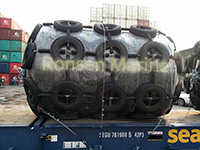
These fenders are encased in a protective net made of steel chains and recycled rubber tires.
Key Features: Extremely high abrasion resistance; sacrificial layer absorbs surface wear before it reaches the PU skin.
Best For: Bulk cargo terminals, ore/coal ports, tug berths, and workboat docks where rough hulls or heavy contact occur.
Trade‑Off: Heavier, more complex to install, and may mark softer hulls.
B. Rope‑Net Foam Fenders
Instead of steel chains, these use high‑strength synthetic fiber ropes (often nylon or polyester).
Key Features: Lighter than chain‑net versions; softer contact with vessel hulls; moderate abrasion protection.
Best For: Small‑to‑medium ports, yacht marinas, passenger terminals where hull aesthetics matter.
Trade‑Off: Less durable in extremely aggressive industrial environments.
C. Skin‑Only (Netless / Coated) Foam Fenders
No external net—protection relies entirely on a thick, high‑performance PU or polyurea coating sprayed directly over the foam core and reinforcement.
Key Features: Smooth, non‑marking surface; easiest to inspect and clean; lowest weight.
Trade‑Off: Dependent on coating quality; less resistant to sharp or abrasive contact.
Foam Fender Classification Comparison: Net‑Type vs Rope‑Net vs Skin‑Only
Aspect
Net‑Type Foam Fender
Rope‑Net Foam Fender
Skin‑Only (Netless) Foam Fender
Abrasion Resistance
Very High
Medium
Medium
Hull Friendliness
Medium
High
High
Weight
High
Medium
Low
Maintenance
Medium
Low
Very Low
2. Classification by Shape / Configuration
Foam fenders are also classified by their geometry and mounting method.
Cylindrical Foam Fenders
The most widely used type—available from 300 mm to 4,200 mm OD, suspended vertically from quay faces or floating freely between vessels. Ideal for general port berthing and ship‑to‑ship (STS) transfer.
Donut (Toroidal) Foam Fenders
Ring‑shaped fenders that slide over a tubular pile and rotate freely with tidal changes.
Best For: Breasting dolphins, bridge piers, lock entrances, ferry terminals.
Boat‑Fender (Hull‑Mounted) Foam Fenders
Continuous or segmented foam rings permanently bonded around a vessel’s hull (tugs, pilot boats, CTVs). Puncture‑proof and custom‑engineered to hull geometry.
3. Classification by Performance Grade (Energy Absorption)
Manufacturers classify foam fenders into performance grades based on foam core density and targeted energy absorption at 60% deflection (standard compression):
Standard (STD) Grade: Baseline energy absorption for normal commercial berthing.
High‑Capacity (HC / HC+) Grade: Increased foam density and reinforced skin for higher berthing energies (bulk carriers, VLCCs).
💡 Note: When comparing grades, multiply the STD energy value by the manufacturer’s grade ratio (commonly 1.3×–1.5× for HC grades).
4. Classification by International Standards
Professional classification also references design and testing standards:
PIANC WG211 (2024): Guidelines for fender system design, energy absorption calculations, reaction force limits, and testing protocols. Recommends hull pressure below 200 kN/m² for most vessel types.
ASTM F2192: Standard test method for determining berthing energy and reaction force.
ASTM D2240: Measures polyurethane hardness (Shore A durometer), typically 75–95 Shore A for foam‑fender skins.
How to Choose the Right Foam Fender Classification
Selecting the correct classification depends on:
Berthing Energy & Vessel Size – Higher energy favors net‑type + HC grade.
Environmental Factors – Temperature range (PU skin typically -40°C to +60°C), UV exposure, chemical splash.
FAQ: Common Questions About Foam Fender Classification
Q: Are foam fenders classified the same way as pneumatic fenders?
A: No. Pneumatic fenders are classified by internal air pressure and type (e.g., Yokohama‑type), while foam fenders are classified by external protection, shape, and foam‑core performance grade.
Q: Can a skin‑only foam fender be used in an oil terminal?
A: Generally not recommended. Oil terminals and container berths typically require chain‑net protection due to higher impact energy and abrasive conditions.
Q: What is the typical service life of each classification?
A: With proper inspection, net‑type and rope‑net fenders often exceed 10–15 years; skin‑only fenders may require recoating after 8–12 years depending on UV and abrasion exposure.
Conclusion
So, what is foam fender classification? It is the organized system of categorizing foam‑filled marine fenders by external protection (chain‑net / rope‑net / skin‑only), shape (cylindrical / donut / boat‑fender), performance grade (STD / HC), and compliance with PIANC WG211 and ASTM standards. Understanding these classifications enables engineers and port operators to match fender specifications precisely to berthing conditions—reducing damage, maintenance costs, and downtime.
1. What Are Floating Yokohama Pneumatic Rubber Fenders?
Floating Yokohama Pneumatic Rubber Fenders are advanced marine buffers designed to absorb the kinetic energy of vessels during berthing and ship-to-ship (STS) transfers. Originally pioneered by the Yokohama Rubber Company, these “Yokohama-type” fenders utilize compressed air as the primary energy-absorbing medium. Unlike solid rubber fenders, they feature a hollow, air-filled structure that allows them to float freely on the water’s surface, adapting seamlessly to tidal fluctuations and varying vessel drafts.
Their core advantage lies in delivering exceptionally low reaction forces to the vessel hull while maintaining high energy absorption capabilities, making them indispensable for protecting mega-structures like VLCCs, LNG carriers, and offshore platforms.
2. Core Construction: The Multi-Layer Architecture
To withstand the immense pressures of marine environments, a high-quality Yokohama fender is constructed with a sophisticated, multi-layered design:
Outer Rubber Layer: This is the first line of defense. Made from a specialized synthetic rubber compound, it provides robust resistance against abrasion, ultraviolet (UV) radiation, and corrosive seawater.
Synthetic-Tire-Cord Reinforcement Layer: Acting as the “skeleton” of the fender, this layer consists of crisscrossed nylon or aramid cords. This reinforcement ensures the fender maintains its structural integrity under high internal pressure and prevents bursting.
Inner Rubber Layer: Seamlessly sealed to retain compressed air, this layer ensures zero leakage and consistent performance over the fender’s lifecycle.
End Flanges and Safety Valves: Equipped with airtight flanges and a critical safety valve (especially on units with a diameter of 2.5 meters or larger) to automatically release excess pressure and prevent catastrophic failure.
3. Key Classifications: Sling-Type vs. Chain & Tire Net (CTN)
Choosing the right external protection system is crucial for extending the service life of your fenders. There are two primary configurations:
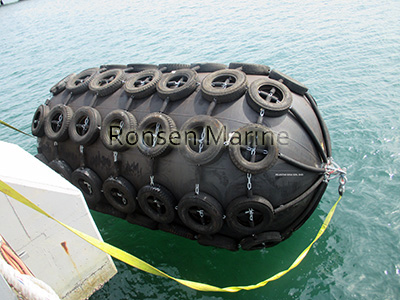
Type I: Chain & Tire Net (CTN) Fenders
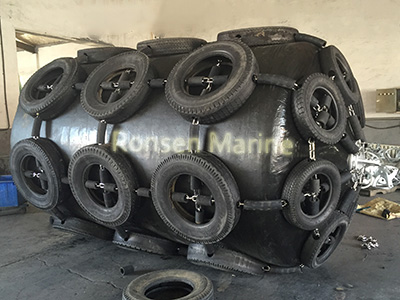
These fenders are encased in a heavy-duty network of chains and used tires. This configuration offers maximum durability in aggressive environments.
Best For: High-traffic ports, rough berthing conditions, and large-scale ship-to-ship transfers.
Pros: Superior resistance to external abrasion and cutting; protects the rubber body from direct impact.
Type II: Sling-Type Fenders
Designed without an external chain net, these fenders are secured using heavy-duty slings or ropes attached to the end flanges.
Best For: Lighter vessels, calm waters, and applications where hull marking must be avoided.
Pros: Lightweight, easier to handle, and more cost-effective for general-purpose use.
4. Technical Specifications: Decoding P50 and P80 Ratings
The performance of a pneumatic fender is primarily dictated by its initial internal pressure, standardized under ISO 17357-1:2014:
Specification
P50 (Pneumatic 50)
P80 (Pneumatic 80)
Initial Internal PressureWorking pressure at 20°C
50 kPa 7.25 psi
80 kPa 11.6 psi
Primary ApplicationTypical use case
Standard Commercial BerthingGeneral cargo, mid-size vessels
Engineering Insight: While P80 fenders offer superior energy absorption, they also exert higher reaction forces on the vessel’s hull. It is critical to match the fender’s pressure rating with the structural capacity of the berthing vessel to prevent hull damage.
5. How to Select the Right Fender Size
Proper sizing requires calculating the Guaranteed Energy Absorption (GEA). A simplified selection guide based on vessel displacement is as follows:
Vessel Tonnage (DWT) Recommended Size (Diameter x Length)
500 – 1,000 tons 1.0m x 1.5m to 1.2m x 2.0m
1,000 – 5,000 tons 1.5m x 3.0m to 2.0m x 3.5m
10,000 – 50,000 tons 2.5m x 4.0m to 3.0m x 5.0m
80,000+ tons (VLCC/LNG) 3.3m x 6.5m or larger
6. Maintenance and Safety Protocols
To maximize the ROI of your floating fenders, adhere to these maintenance best practices:
Pressure Monitoring: Regularly check internal pressure with a calibrated gauge. Deviations of more than 10% from the initial setting indicate a leak.
Visual Inspections: Every 3 to 6 months, inspect the outer rubber for deep cuts, the chain net for rust, and the safety valve for blockages.
Cleaning: Rinse fenders with fresh water after prolonged exposure to saltwater to prevent salt crystallization and rubber degradation.
Storage: When not in use, store fenders in a cool, shaded area. Deflate them to approximately 20-30% of their working pressure to relieve stress on the rubber layers.
A pneumatic rubber fender—often called a Yokohama fender—is a floating, cylindrical marine fender inflated with compressed air that acts as a shock absorber between two vessels (STS) or between a vessel and a dock (STD). Its reinforced-rubber body compresses under impact, using air compression to absorb berthing energy while keeping reaction force and hull pressure extremely low. Pneumatic fenders are the global standard for ship-to-ship transfers, LNG berthing, and offshore platforms because they automatically follow tidal changes and vessel movement.
Table of Contents
How Pneumatic Rubber Fenders Work (The Air-Spring Principle)
Internal Structure: 4 Engineered Layers
Key Advantages Over Solid & Foam Fenders
P50 vs P80: Which Initial Pressure Rating to Choose
Types: Net Type vs Sling Type vs Hydro-Pneumatic
Standard Sizes & ISO 17357-1:2014 Performance Tables
Pneumatic vs Foam-Filled vs Cell Fender Comparison
How to Select the Right Pneumatic Fender
Installation, Inflation & Maintenance Best Practices
Service Life & Storage Guidelines
FAQ: People Also Ask
Conclusion & Next Steps
1. How Pneumatic Rubber Fenders Work (The Air-Spring Principle) {#how-pneumatic-rubber-fenders-work}
The working principle is based on air compression. When a vessel makes contact:
The fender’s rubber body deforms and internal air pressure rises.
Kinetic energy from the vessel is absorbed gradually as the air compresses.
Reaction force stays relatively low and stable thanks to the “air spring” effect.
At 60% deflection (the ISO 17357 standard test point), energy absorption peaks while hull pressure remains within safe limits.
Once the load is removed, the air expands and the fender returns to its original shape.
Because they float on the water surface, pneumatic fenders automatically adjust to tidal changes and vessel roll/pitch—something fixed fenders like cell or cone fenders cannot do.
✅ Large contact area – Conforms to curved or irregular hull shapes, spreading impact evenly.
✅ Easy to deploy & relocate – Can be moved between berths or vessels as needed.
✅ Proven for STS operations – The industry standard for ship-to-ship cargo transfer and offshore lightering.
4. P50 vs P80: Which Initial Pressure Rating to Choose {#p50-vs-p80}
Pneumatic fenders come in two standard initial internal pressures per ISO 17357-1:2014:
ParameterP50 (50 kPa)P80 (80 kPa)Energy absorptionBaseline (ISO GEA)~20–30% higher than P50 at same sizeReaction forceLowerHigherHull pressureLower – ideal for sensitive hullsHigher – check hull limitsFender size for same EALarger diameter neededSmaller diameter possibleBest use casesSheltered berths, STS, general cargoOffshore STS, VLCC/LNG, tight spacesMaintenanceEasier, more forgivingStricter – needs regular pressure checks
Protects inner layers from UV, seawater, impact, and chafing
2Cord Fabric Layer Reinforcement Layer
Synthetic tire-cord fabric (nylon/polyester) wound at precise anglesTire-Cord Fabric
Provides tensile strength; prevents bursting under pressure
3Inner Rubber Airtight Seal Layer
Airtight, low-permeability rubberSealant Rubber
Seals compressed air inside; prevents leakage
4End Flanges & Fittings Hardware Layer
Galvanized or stainless steel with air/safety valvesSteel + Valves
Allows inflation/deflation and secure lifting/anchoring
Engineering Note: All four layers work as an integrated system. Failure in any single layer compromises the entire fender’s performance and safety. Compliant with ISO 17357-1:2014; third-party certifications available (BV, ABS, CCS, DNV, LR).</p >
Rule of thumb: Choose P50 if hull pressure is your constraint (LNG, aluminum, yacht, naval). Choose P80 if you’re tight on space and need maximum absorption per fender—but verify your hull/dock can take the extra reaction force.
⚠️ Never overinflate a P50 fender to 80 kPa. The reinforcement layers and safety factors are different between the two designs.
5. Types: Net Type vs Sling Type vs Hydro-Pneumatic {#types-of-pneumatic-fenders}
🔹 Chain-Tire Net (CTN) Type
Protective net of chains and used aircraft tires. Extremely durable for heavy STS and rough environments. Downside: tires can scuff delicate hull paint.
🔹 Sling Type
Heavy-duty nylon straps instead of chains/tires. Gentler on hull coating—preferred for yachts, navy vessels, and LNG where surface finish matters.
🔹 Rope Net Type
Rope protection net offering a balance between weight and durability. Often used for mid-sized vessels.
🔹 Hydro-Pneumatic Type
Partially submerged, designed for submarines and vessels with very low freeboard. Not covered by ISO 17357-1 (falls under separate specifications).
6. Standard Sizes & ISO 17357-1:2014 Performance Tables {#standard-sizes}
Common ISO 17357 pneumatic fender sizes:
📊 ISO 17357-1:2014 Performance Table
Pneumatic Rubber Fender · Guaranteed Energy Absorption & Reaction Force at 60% Deflection 🌐 ISO 17357-1:2014 Compliant
Nominal Size (Ø × L, mm)
P50 (50 kPa)
P80 (80 kPa)
GEA (kJ)
R (kN)
GEA (kJ)
R (kN)
500 × 1000
6
64
8
85
1000 × 1500
32
182
45
239
1000 × 2000
45
257
63
338
2000 × 3500
308
875
430
1,150
2500 × 4000
663
1,381
925
1,815
3300 × 6500
1,814
3,015
2,532
3,961
4500 × 9000
4,755
5,988
6,633
7,551
GEA = Guaranteed Energy Absorption (kJ) · R = Reaction Force (kN) · All values measured at 60% deflection per ISO 17357-1:2014. P50 fenders operate at 50 kPa initial internal pressure; P80 fenders at 80 kPa. Never overinflate a P50 fender to 80 kPa — the reinforcement design differs between the two.
P50 — Standard Pressure (50 kPa)
P80 — High Pressure (80 kPa)
All values at 60% deflection per ISO 17357-1:2014. GEA = Guaranteed Energy Absorption; R = Reaction Force.
💡 Sizing insight: A Ø3.3m × L6.5m P80 fender absorbs ~2,532 kJ at 60% deflection—enough for VLCC-to-VLCC side-by-side transfer. Always verify with manufacturer performance curves, not just dimensional tables.
7. Pneumatic vs Foam-Filled vs Cell Fender Comparison {#comparison-table}
Source synthesis from industry references.
8. How to Select the Right Pneumatic Fender {#selection-guide}
Step 1: Calculate Berthing Energy (E)
Use the PIANC methodology:
E = \frac{1}{2} M_e V^2 C_e C_m C_s C_c
Where:
M_e = Effective displacement (vessel mass + added mass of water)
V = Approach velocity (typical 0.10–0.30 m/s for large vessels under tug assist)
Select fender size so that absorbed energy ≤ GEA at 60% deflection, with reaction force ≤ hull/structure limits.
Step 4: Choose Type & Accessories
STS heavy duty → CTN type, P80
Yacht/naval → Sling type, P50
Submarine → Hydro-pneumatic
⚠️ Common mistake: Specifying based on dimensional size alone. Two fenders with the same Ø×L can have vastly different energy absorption if pressure ratings differ. Always use ISO performance tables.
9. Installation, Inflation & Maintenance Best Practices {#installation-maintenance}
Pre-Deployment Checklist:
✅ Inflate with clean, dry air or nitrogen to rated initial pressure
✅ Verify safety relief valve functions correctly
✅ Inspect chain/tire net or sling for corrosion, wear, or loose connections
✅ Confirm end-flange bolts and shackles are tightened to spec
Routine Maintenance:
Pressure checks: Monthly or before each operation. Temperature changes affect pressure—hot sun can raise pressure 10–15%.
Visual inspection: Check for cuts >1 cm deep, exposed cord fabric, valve leakage, or tire-net wear.
Cleaning: Rinse with fresh water after heavy fouling to remove salt/silt.
Valve service: Replace valve cores every 6 months in high-use environments.
Storage (when not in use):
Deflate partially or fully
Store in cool, dry, well-ventilated area away from direct sunlight and ozone sources (electric motors, welding equipment)
Keep away from sharp objects and chemicals
10. Service Life & Storage Guidelines {#service-life}
With proper maintenance, a high-quality pneumatic fender typically lasts 10–15 years. Factors affecting lifespan:
Q: Are pneumatic fenders the same as Yokohama fenders?
A: Yes. “Yokohama fender” is the industry tradename, named after The Yokohama Rubber Co., which pioneered them. Technically they are floating pneumatic rubber fenders.
Q: Are pneumatic fenders ISO certified?
A: Reputable manufacturers produce to ISO 17357-1:2014 (high-pressure) or ISO 17357-2 (low-pressure). Always request third-party certs (BV, ABS, CCS, DNV, LR).
Q: Can pneumatic fenders be used on a fixed dock instead of cone fenders?
A: They can, but usually shouldn’t if the berth is permanent and high-traffic. Pneumatics cost more to maintain (air checks, net wear) and can drift if not properly tensioned. Fixed docks typically do better with Super Cone or cell fenders, reserving pneumatics for STS or extreme tidal cases.
Q: What’s the difference between pneumatic fenders and marine airbags?
A: They are not interchangeable. Marine airbags are for ship launching and salvage (pure buoyancy + rolling). Pneumatic fenders are certified berthing devices with ISO performance tables. Different tool, different job.
Q: How often should I inspect pneumatic fenders?
A: At least quarterly, or after any major impact or severe weather event. High-traffic terminals may require monthly checks.
Q: Can I repair a punctured pneumatic fender?
A: Small cuts can be patched with cold-cure rubber patches. Large damage or cord exposure requires professional factory repair or replacement.
12. Conclusion & Next Steps {#conclusion}
Pneumatic rubber fenders remain the gold standard for floating, low-reaction-force marine protection—especially for ship-to-ship transfers, LNG terminals, and offshore platforms where fixed fenders cannot adapt to tidal and vessel movement. Selecting the right combination of size, pressure rating (P50/P80), and protection type (CTN/Sling/Hydro) requires matching berthing energy calculations to ISO 17357 performance curves—not guesswork.
Need Help Sizing Your Pneumatic Fender System?
Our marine engineering team can calculate berthing energy for your specific vessel class, recommend optimal Ø×L and pressure rating, and provide ISO 17357-compliant drawings and performance curves.

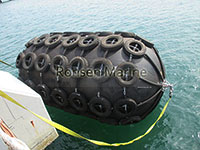
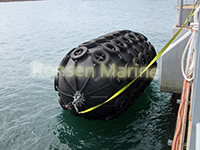
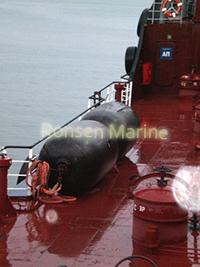
 Standards: ISO 14409:2011, ISO 17682:2013; class endorsements CCS/ABS/BV/DNV/LR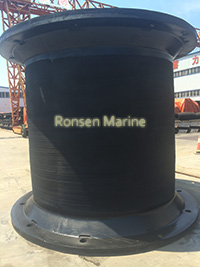
 When safety, durability, and low maintenance are top priorities, shipowners and port authorities turn to one solution: the foam filled fender. Also known as a solid polyurethane fender or EVA foam fender, this technology represents a major leap forward from traditional inflatable systems. But what exactly is it, and why is it considered “unsinkable”?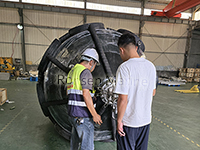
 Performance in Extreme Conditions
 The marine airbag launch ship procedure is a flexible, cost‑effective method of moving a newly built or repaired vessel from the shipyard slipway into the water using inflated cylindrical rubber airbags as rollers. Also known as
  Before diving into the procedure, here’s why shipyards choose airbag launching:


 4. Classification by International Standards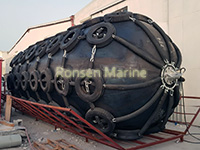
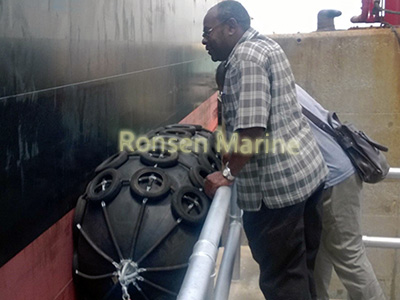
 Choosing the right external protection system is crucial for extending the service life of your fenders. There are two primary configurations:
 Type II: Sling-Type Fenders