
What Is Marine Airbag Launch Ship Procedure?
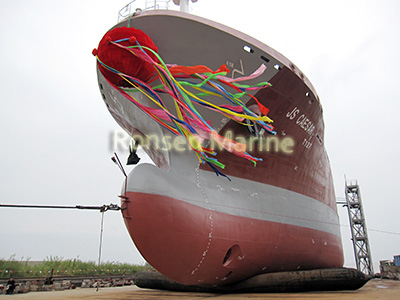 The marine airbag launch ship procedure is a flexible, cost‑effective method of moving a newly built or repaired vessel from the shipyard slipway into the water using inflated cylindrical rubber airbags as rollers. Also known as airbag ship launching or inflatable roller bag launching, this technique replaces traditional dry docks or fixed slipways with portable, reusable marine airbags that bear the ship’s weight and allow it to roll smoothly into the water under controlled speed .
Marine airbags are made of multi‑layer synthetic rubber reinforced with high‑tensile fabric. Once placed under the hull and inflated, they lift the vessel off its keel blocks and act as low‑friction rollers, enabling end‑on or side launching with minimal infrastructure .
Advantages of the Marine Airbag Launching Method
 Before diving into the procedure, here’s why shipyards choose airbag launching:
✅ Lower cost – No permanent slipway or dry dock required
✅ Reusable equipment – Airbags can be used for multiple launches
✅ Adaptable – Suitable for small boats to large cargo vessels
✅ Reduced hull stress – Even load distribution and shock absorption
✅ Eco‑friendly – Minimal land alteration and seabed disturbance
Pre‑Launch Preparation (Site & Equipment Checks)
A safe launch begins long before inflation. Key preparatory steps include:
- Hull Inspection – Grind down sharp welds, burrs, or protruding fittings on the hull bottom. Close all sea valves, thrusters, and hull openings.
- Slipway Preparation – Level the launch path, remove nails, stones, or debris that could puncture airbags. Cross‑slope error should typically be <80 mm for small vessels and <50 mm for larger ones.
- Water Depth Check – Ensure sufficient water depth (commonly ≥1.5× the ship’s draft) at the entry point to prevent grounding.
-

Airbag Selection & Inspection – Choose airbags with adequate diameter, length, and safety factor (typically 1.5–2× vessel weight). Inspect for cracks, leaks, or valve damage.
- Rigging & Winch Setup – Install holding winches, wire ropes, pulleys, and ground anchors to control vessel movement. Test compressors and hoses.
Step‑by‑Step Marine Airbag Ship Launching Procedure
Step 1: Position the Airbags
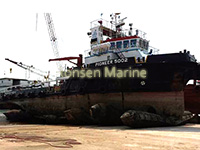
Place deflated marine airbags transversely (perpendicular to the launching direction) under the keel at calculated intervals. Spacing depends on vessel length, weight, and airbag load capacity. Extra airbags may be added under heavier mid‑ship sections .
Step 2: Inflate the Airbags & Lift the Hull
Connect air hoses to the compressors. Inflate gradually (typical working pressure 0.03–0.08 MPa / 0.3–0.8 kg/cm² depending on size). As pressure builds, the airbags lift the hull evenly off the wooden keel blocks. Remove all blocks once the hull is fully supported by airbags .
⚠️

Never exceed the airbag’s maximum rated pressure. Use a calibrated pressure gauge throughout.
Step 3: Adjust Pressure & Align the Vessel
Fine‑tune individual airbag pressures to keep the hull level. Misaligned or uneven pressure can cause tilting or airbag damage. Ensure airbags remain perpendicular to the launch path and do not twist during movement .
Step 4: Controlled Rolling Toward the Water
With the holding winch keeping the vessel stationary, release the brake slowly to let the ship roll forward on the inflated airbags. Typical forward speed is 0.5–1 m/s (≈6–13 m/min), controlled by winch tension. Use guide ropes if the vessel tends to veer off course .
Step 5: Final Launch Into the Water
When the hull reaches the water entry point, continue controlled release until buoyancy takes over. For narrow waterways, maintain winch control throughout. For open areas, the final hold‑back wire may be released or cut at the appropriate moment .
Step 6: Deflate, Recover & Inspect
Once afloat:
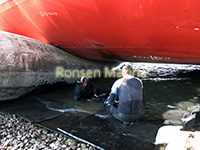
Slowly deflate airbags (below 0.03 MPa before disconnecting hoses).
Recover airbags from the water, inspect for punctures or deformation.
Clean, dry, and store airbags in a cool, shaded area.
Check the vessel for watertight integrity and measure bow/stern draft .
Key Safety Tips for Airbag Ship Launching
👷 All personnel must wear helmets, life jackets, and anti‑slip footwear.
🚧 Keep non‑essential staff out of the launch zone.
🌬️ Avoid launching in wind speeds above Beaufort Force 6, heavy rain, or rough seas.
🔧 Install pressure relief valves on compressors to prevent over‑inflation.
📋 Conduct a pre‑launch risk assessment and toolbox talk .
FAQ: Common Questions About Marine Airbag Launch Procedure
Q: Can marine airbags be used for any size ship?
A: Yes. With proper calculation of airbag diameter, length, quantity, and safety factor, airbags can launch vessels from small fishing boats to large ocean‑going ships .
Q: What slope is required for an airbag launch slipway?
A: Typical slopes range from 1:7 to 1:15, depending on vessel size and site conditions .
Q: How are airbags arranged under the hull?
A: Common layouts include single‑row linear, staggered, or double‑row arrangements, chosen based on beam width and airbag effective length .
Conclusion
So, what is marine airbag launch ship procedure? It is a systematic, engineer‑led process involving site preparation, calculated airbag placement, controlled inflation, gradual hull lifting, winch‑controlled rolling, and safe water entry—followed by recovery and inspection. When executed with proper planning and safety protocols, marine airbag launching offers shipyards a flexible, economical, and reliable alternative to traditional launching methods.

