
What Is Yokohama Type Fender
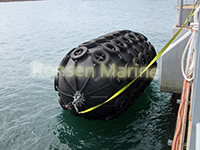
A Yokohama type fender is a floating pneumatic rubber fender—a cylindrical, air-filled, cord-reinforced marine buffer that absorbs berthing energy between a ship and a dock or between two vessels. The name comes from The Yokohama Rubber Co., which commercialized the design in the 1950s; today “Yokohama type fender,” “Yokohama fender,” and “pneumatic rubber fender” are used interchangeably, with performance governed by ISO 17357-1:2014.
Why Is It Called “Yokohama Type” and Not Just “Pneumatic Fender”
Yokohama Rubber pioneered the compressed-air marine fender using tire-cord and rubber-tank technology. Because the brand became the global benchmark, buyers still say “Yokohama type” even when procuring from any ISO-compliant manufacturer.
Key naming logic:
- Yokohama® fender = original branded product
- Yokohama type fender = generic shape/compliance class (pneumatic, floating)
- Pneumatic rubber fender = technical standard term
- Floating pneumatic fender = emphasizes self-buoyancy at the waterline
In a purchase spec, “Yokohama type” alone is not enough—always state ISO 17357-1:2014, P50 or P80, diameter × length, and net/sling type.
How a Yokohama Type Fender Works
It uses an air-spring principle, not solid-rubber compression:
- Vessel approaches → fender floats at waterline, tethered by sling or chain pendant
- Hull contact → reinforced rubber body compresses
- Internal air pressure rises uniformly (no local buckling)
- Kinetic energy converts to air compression + elastic cord-layer strain (up to ~70% absorbed)
- Reaction force stays low → protects hull and quay
- Vessel backs off → air re-expands, fender recovers shape
At the ISO test point of 60% deflection, makers publish GEA (Guaranteed Energy Absorption) and R (reaction force). A 2500 × 5500 mm P50 fender gives ~943 kJ GEA at ~2019 kN reaction.
Internal Structure (ISO 17357-1 Four Layers)
[supsystic-tables id=27]
The body is vulcanized seamless; chains or slings attach to flanges, never the rubber skin.
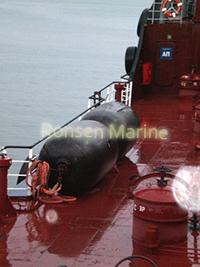
Types of Yokohama Type Fenders
Net Type (ISO Type I – Chain & Tire Net)
Chain/wire net with used tires or rubber sleeves around the body.
- Use: VLCC/LNG STS, permanent berths, rough seas
- Pros: Longest abrasion life, hardest impact tolerance
- Size range: Ø500 mm – Ø4500 mm
Sling Type (ISO Type II – No Net)
Thick outer rubber + integral lifting slings.
- Use: Yachts, naval, cruise, calm-water temporary berthing
- Pros: Lightweight, non-marking options, fast deploy
- Size range: Ø500 mm – Ø3300 mm[ccitation:2]
Hydro-Pneumatic Fender
Part air, part water ballast, held vertically submerged.
- Use: Submarines, low-freeboard hull contact, naval sub-surface ops
- Always custom-engineered
P50 vs P80 (Initial Pressure Class)
[supsystic-tables id=28]
Never inflate a P50-rated body to 80 kPa—cord angle and end-ring safety factor differ.
Yokohama Type vs Foam vs Solid Fender
- Yokohama / pneumatic: air spring, floating, low reaction, deflatable for shipping
- Foam-filled: closed-cell foam, floating, no pressure upkeep, heavier
- Solid rubber (cell/cone): fixed to quay, no tidal tracking, higher hull pressure
Pneumatic wins for STS, tidal STD, and sensitive hulls.

Where Yokohama Type Fenders Are Used
- Ship-to-ship (STS) crude/LNG/product transfers
- Ship-to-dock (STD) tidal wharves and marginal berths
- FPSO / FSU offloading
- SPM and CBM buoy mooring
- Naval berthing and submarine tendering
- Offshore wind CTV docking
- Emergency lay-by fenders
How to Specify One Correctly
Minimum compliant line item:
Yokohama type pneumatic rubber fender, ISO 17357-1:2014, P50, 3300 × 6500 mm, Type I chain-tire-net, with BV prototype test, safety valve, mill cert.
Verify: GEA/R at 60% deflection, cord specification, relief valve on ≥Ø2500 mm, third-party class report (ABS/BV/DNV/CCS/LR).
Maintenance Basics
- Check pressure monthly (±10% of rated)
- Inspect chain nets/tire wear every 3–6 months
- Wash salt, store shaded, away from ozone/heat
- Keep safety valve functional
- Typical service life: 6–10 years with correct care
FAQ
Is Yokohama type fender the same as pneumatic rubber fender?
Yes. “Yokohama type” is the generic trade-origin name; “pneumatic rubber fender” is the ISO technical name. Both mean a floating, air-filled, cord-reinforced marine fender.
What does P50 mean on a Yokohama fender?
P50 means the initial internal air pressure is 50 kPa at 20 °C per ISO 17357-1:2014. P80 means 80 kPa.
Do all Yokohama fenders float?
Yes—by definition a pneumatic Yokohama type fender is self-floating and tracks tide/swell. Fixed “Air Block” variants exist but are not the floating pneumatic class.
How long does a Yokohama type fender last?
6–10 years typical, depending on pressure discipline, net type, and UV exposure.

