
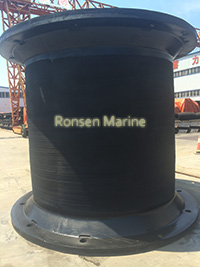
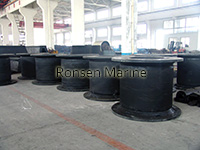
Cell rubber fenders are high-performance compression-type marine rubber fenders installed on quay walls, wharves, and terminal berths to absorb vessel berthing energy and protect both the ship hull and the dock structure. Their name comes from the hollow, cell-like cylindrical rubber body that compresses axially during impact, buckles radially in a controlled way, and rebounds after the vessel departs.
In short: a cell rubber fender is a fixed, heavy-duty dock fender system that turns the kinetic energy of a berthing ship into safe elastic deformation—while keeping reaction force and hull pressure low.
What Is a Cell Rubber Fender (Simple Definition)
A cell rubber fender consists of:
- A hollow cylindrical rubber body (the “cell”) with large flanged ends
- A steel frontal panel that widens the contact area with the vessel
- UHMW-PE face pads that lower friction between hull and panel
- Anchor bolts, chains, and mounting hardware fixed to the quay
When a vessel approaches the berth, the rubber cell compresses. The frontal panel spreads the load, the UHMW-PE pad lets the hull slide slightly without gouging, and the rubber absorbs energy instead of transferring a hard shock to the concrete wall or the ship’s side.
How Cell Rubber Fenders Work
The working principle is elastic energy absorption:
- Berthing impact – A ship carries kinetic energy: E ≈ ½ × M × v² × C (PIANC 2002 method), where M is displacement, v is approach speed, and C is an energy coefficient.
- Axial compression – The cylindrical rubber column shortens. Typical rated deflection is 47.5% for standard cell fenders and up to 52.5% for super cell (SC) types.
- Radial buckling – The cell wall buckles outward in a controlled pattern, dissipating energy uniformly in all directions.
- Low reaction transfer – Because the frontal panel is large, hull pressure stays low (often <50 kPa or <25 t/m² on request).
- Recovery – After the vessel leaves, the rubber returns close to its original shape and is ready for the next berthing.
Standard vs. Super Cell Rubber Fenders
FeatureStandard Cell FenderSuper Cell (SC) FenderRated deflection~47.5%~52.5%E/R.H ratio*0.375–0.3850.43–0.44Energy gainBaseline~15% higher efficiencyBolt pitchConventionalSame as standard (retrofit-friendly)Best forMedium berthsContainer terminals, VLCC, LNG docks
*E/R.H = Energy absorption ÷ (Reaction force × Height). Higher is better.
Key Specifications
- Height range: 400 mm – 3000 mm
- Diameter range: 650 mm – 3350 mm
- Rubber compound: Natural rubber (NR), NR/SBR blend, cold-resistant or ozone-resistant grades
- Reaction force classes: RL (low) to RE (extra high)
- Standards: Tested and reported per ISO 17357, PIANC 2002; certificates from DNV, BV, ABS, LR, CCS, etc.
Why Ports Choose Cell Rubber Fenders
- High energy absorption, low reaction force – ideal for large vessels and weak quay walls.
- Stable under angular berthing – performs well when ships contact at an angle.
- Long service life – 10–20 years in normal marine conditions with inspections.
- Low hull pressure – frontal panel + UHMW-PE pad protects expensive hulls (LNG, cruise, naval).
- Retrofit capable – SC types keep the same bolt-hole pattern as older cell fenders.
Typical Applications
- Container terminals and mega-wharves
- Bulk cargo and grain berths
- Oil, chemical, and LNG terminals
- Navy piers and cruise ship terminals
- Offshore platform legs and dolphin structures
How to Select the Right Cell Fender
- Calculate berthing energy using vessel displacement and approach speed (PIANC method).
- Check allowable reaction force from hull and quay design.
- Match E and R from the manufacturer’s compression table—not just diameter.
- Size the frontal panel – too small = high local hull pressure.
- Add safety factor 1.25–1.5 for wind, current, and overspeed cases.
- Verify ISO 17357 batch test report, not only a catalog average.
Maintenance Tips for Long Life
- Monthly: visual check for cuts, embedded debris, panel alignment
- Quarterly: verify rebound after compression
- Annually: bolt torque, UHMW-PE wear, rubber cracking, chain corrosion
FAQ
Q: What is cell rubber fenders used for?
A: Cell rubber fenders are used on docks and quays to absorb the kinetic energy of berthing ships, reduce reaction force on the quay, and lower hull pressure on vessels.
Q: What is the difference between cell and super cell fender?
A: A super cell (SC) fender achieves about 52.5% deflection and roughly 15% better E/R.H efficiency than a standard cell fender, while keeping the same bolt layout for easy replacement.
Q: Are cell rubber fenders better than pneumatic fenders?
A: They serve different roles. Cell fenders are fixed berth infrastructure for permanent daily protection; pneumatic (Yokohama-type) fenders are floating, portable units for ship-to-ship or temporary use.
Q: What standard covers cell rubber fender performance?
A: Performance is usually tested and reported under ISO 17357, with design guidance from PIANC 2002 MarCom WG33.

