
How Do General Surface Support Buoys Work?
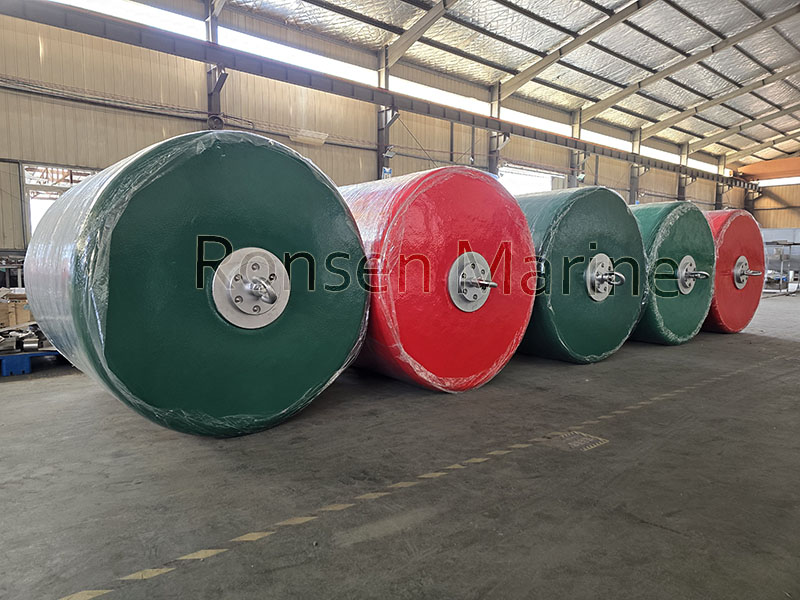
A general surface support buoy works by displacing water with a permanently buoyant closed-cell polyethylene (PE) or EVA foam core to support the submerged weight of mooring chains, ropes, hoses, or cables—while an internal steel frame carries the tensile load and a polyurethane skin resists the marine environment. There is no air chamber to inflate or lose, so the buoy cannot sink even if the skin is cut.
In short: it is not an energy absorber like a fender—it is a floating load-relief block that keeps mooring lines partially suspended, reduces seabed drag, and acts as a shock buffer (“self-fendering”) when hulls or chains slap against it.
What Is a General Surface Support Buoy?
A general surface support buoy (sometimes written “general surface foam buoy”) is a cylindrical or chain-through floating body used in:
- Single-point mooring (SPM) systems
- Mid-line chain support for tanker moorings
- Subsea cable and flexible hose lay operations
- Pick-up / messenger buoys for offshore transfer
- Dredge pipe and discharge hose support
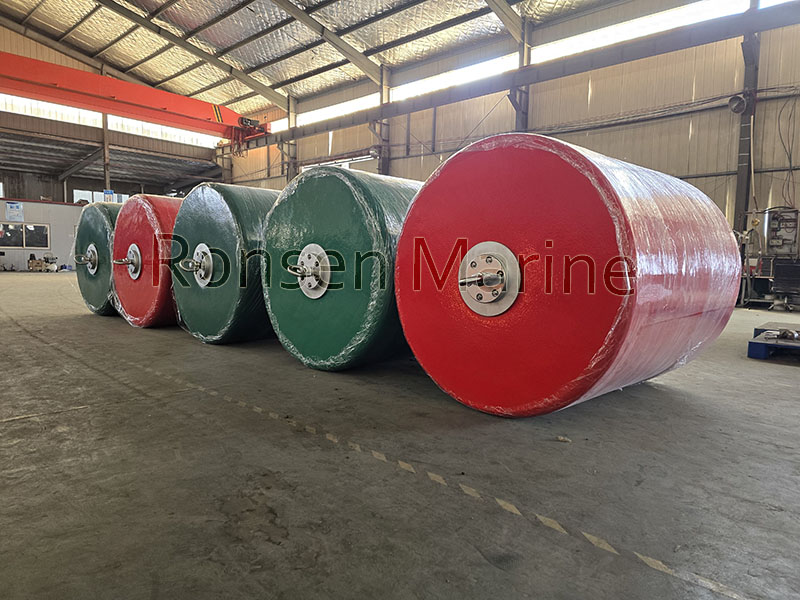
Three common subtypes:
- Cylindrical Buoy (CB) – central tension member or clevis eyes, chain attached externally
- Chain-Through Buoy (CTB) – central tube lets the mooring chain pass through and lock at one/both ends
- Pick-Up Buoy (PU) – smaller unit for marker / messenger / mooring pickup duties
The 3-Part Structure That Makes It Work
LayerMaterialFunctionFlotation coreThermo-laminated closed-cell PE or EVA foamPermanent buoyancy; cells stay dry if skin is breachedInternal steelworkCentral tube, gussets, load flanges (hot-dip galvanized / epoxy)Takes tensile/working load; foam never sees pure tensionOuter skinSprayed polyurethane (PU) or polyurea elastomer, often nylon-filament reinforcedAbrasion, UV, seawater, marine-growth resistance
The foam is cross-linked and thermo-laminated around the steel mandrel so the two act as one monolithic block. Because the steel carries the chain tension and the foam only carries compression/buoyancy, the core will not tear under mooring load.
The Working Principle, Step by Step
- Archimedes does the work – the closed-cell foam core displaces a volume of water heavier than the buoy’s own weight plus the submerged weight it must lift. Net upward force = buoyancy reserve (freeboard control).
- Chain/rope is partially supported – in an SPM midline, the buoy suspends a portion of the chain’s submerged weight, reducing ground chain drag and improving catenary behavior.
- Steelwork takes the load – SWL (safe working load) is set by the central tube and end flanges, not the foam. The foam is there for displacement, not strength.
- Self-fendering on impact – when a hull, chain, or tug brushes the buoy, the resilient foam core compresses locally and rebounds. This is secondary behavior (unlike a foam fender’s primary EA role), but it removes the need for separate rubbing strips.
- Damage does not sink it – cut the PU skin and seawater hits closed cells; each cell is sealed, so no water ingress, no loss of displacement, no deflation event.
- Tide/swell tracking – because it floats by solid displacement, it rises and falls with water level, keeping the chain geometry stable without powered adjustment.
Buoyancy Sizing Logic (Why It’s Not Like a Fender)
You do not size a support buoy by berthing energy. You size it by:
B_{net} = \rho_{sw} \cdot g \cdot V_{displaced} – W_{buoy} \geq W_{submerged\_line} + F_{freeboard}
Where:
- \rho_{sw} ≈ 1025 kg/m³ (seawater)
- V_{displaced} = outer volume minus steelwork volume
- W_{submerged\_line} = chain/rope/hose submerged weight (length × (unit weight in air − buoyancy))
- F_{freeboard} = reserved lift to keep the buoy riding at target height
Typical PE/EVA core density 40–70 kg/m³ gives ~950–980 N·m³ net lift in seawater after deducting foam self-weight.
Support Buoy vs Foam Fender (Same Foam, Different Job)
AspectGeneral surface support buoyFoam-filled fenderPrimary jobProvide flotation / reduce line tensionAbsorb vessel kinetic energy at berthingLoad pathSteel core takes tension; foam takes compressionFoam core takes compression; skin takes shearRated byNet buoyancy (kN) + SWL (kN)Energy absorption (kJ) @ 60% defl. + RF (kN)Deflection basisNone (rigid float)60% deflection performance curveCommon useSPM chains, hose/cable supportQuay, STS, offshore boat landingSelf-fenderingYes, secondaryYes, primary
Both share the closed-cell foam + PU skin recipe, which is why vendors often cross-sell them—but the hydrodynamic role is opposite.
Why “Unsinkable” Holds Up
Air-filled buoys lose displacement the moment the envelope leaks. A general surface support buoy’s displacement comes from solid polymer foam whose cells are already gas-filled at manufacture and sealed. Puncture the skin → cells stay dry → displacement unchanged → buoy stays at the surface until you re-skin it. That is why OCIMF-style SPM specs and PIANC buoyancy guidance favor foam-core units for unattended offshore lines.
Where They Are Specified
- Tanker SPM main header and mid-line chain support
- CALM buoy pendant support
- Subsea power/fiber cable laying (temporary floatation)
- Dredging discharge hose support
- Offshore wind SOV guide/marker buoys
- Navy/port temporary mooring pick-up
FAQ
How does a surface support buoy float without air?
Its closed-cell PE/EVA foam core displaces seawater permanently; the gas inside each foam cell is sealed at manufacture, so no inflation and no deflation path exists.
Is a support buoy the same as a fender?
No. A support buoy carries mooring-line weight and provides flotation; a fender absorbs berthing impact energy. Support buoys are “self-fendering” only as a side benefit.
What happens if the PU skin is torn?
Nothing structurally critical—closed cells block water entry, buoyancy holds, and the unit stays in service until patched or re-skinned.
How long do general surface support buoys last?
10–15 years typical in offshore service with annual skin/steelwork inspection; tropical UV and ice zones shorten skin life but not core buoyancy.
How do you calculate the right buoy size?
Sum the submerged weight of the chain/rope/hose segment you want lifted, add freeboard reserve, divide by net lift per m³ of foam core (~9.5 kN/m³ seawater), then match SWL to your central steelwork rating.

