Uncategorized

  • 16 Jun

    What Is the Inspection Procedure of Ship Launching Airbags?

    Ship Launching Airbags

    All ship launching airbags must meet the following test criteria.

    How is the test condition?

    Unless otherwise specified, tests shall be performed under the following conditions:

    a)  ambient temperature: 10 degree ~35 degree

    b)  media: (1) dry clean compressed air, and (2) clean fresh water for bursting test.

    Testing instruments, including pressure gauages and testing machine, shall be calibrated.

    The test shall be performed using a full-sized air bag. If the air bag is too large to be mounted on the test machine, the test may be performed on a scaled-down air bag. In order to maintain a proper representation of the full-sized sample airbag, the diameter of the scaled-down air bag shall be no less than 1/2 of the full-sized sample air bag diameter while the length (L) shall be no less than 3 times the diameter of the scaled-down air bag.

    Compression Test

    Compression test under the initial internal pressure specified in Table 3 should be carried out after the tests of 5.1, 5.2, 5.3 and 6.3

    The air bag is to be put on a press with large enough width and length to ensure that all parts of the compressed air bag is within the press. The test should be conducted as follows:

    a) fill the air bag to the initial pressure in Table 3, start the test machine and press the air bag perpendicularly till the percentage deformation reaches 70%. Observe to see if the air bag is functioning properly;

    b) gradually reduce the compressive force on the air bag until the air bag, by its own flexibility, returns to the height of its original state. Record the internal pressure;

    c) apply a compressive force perpendicularly to the air bag again, till the percentage deformation reaches 70%

    During the course of compressing and releasing, the reaction forces, internal pressures and deformation rate should be recorded at every 10% deformation interval.

    The compression performance curve of a QG6 air bag is shown in Figure A.1. The rated working pressure of the air bag is as specified in Table 3.

    By Ronsen Marine News Uncategorized
  • 13 Jun

    What is Marine Airbags?

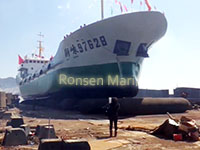
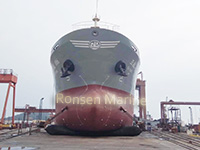
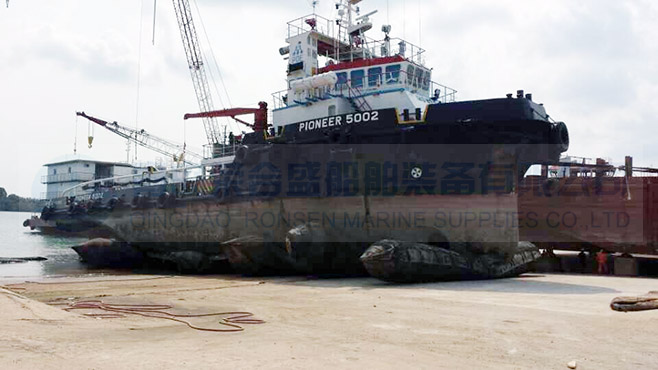
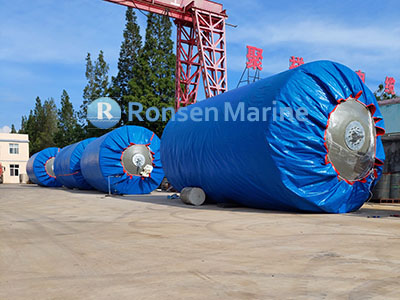
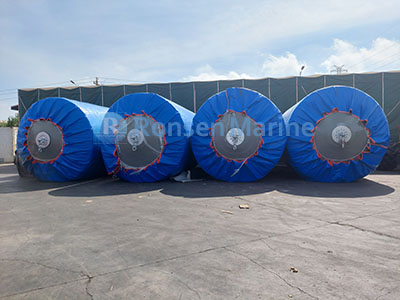
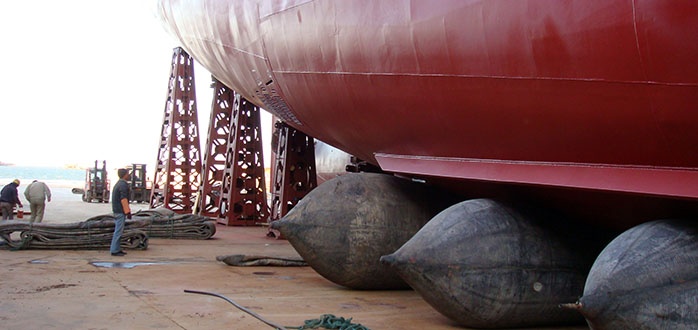
    Ship Launching AirbagsShip Launching Airbags are also referred to Marine Airbags, which is a ship operation equipment made of high-strength rubber and synthetic fiber, featuring a reinforced layer of fabric and wear-resistant rubber structure. It includes an inflation valve and a tow-end assembly, generating buoyancy to support the ship’s weight through inflation. Its production complies with the JT/T 302-1996 “Technical Specification for Marine Airbags,” and has obtained international certifications such as from China Classification Society and French Bureau Veritas. It is primarily used in scenarios like ship launching, caisson transportation, and heavy cargo handling, capable of withstanding the launching pressure of vessels with a deadweight tonnage of 100,000 tons. The burst pressure exceeds industry standards, and the air tightness pressure loss is less than 3% within 24 hours.

    Marine AirbagsWhat is bearing capacity of air bag?

    It is maximum load carrying capacity of the air bag, while it suffers no permanent deformation or damage

    What is body of air bag?

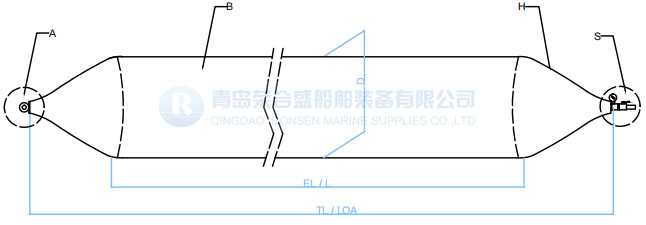
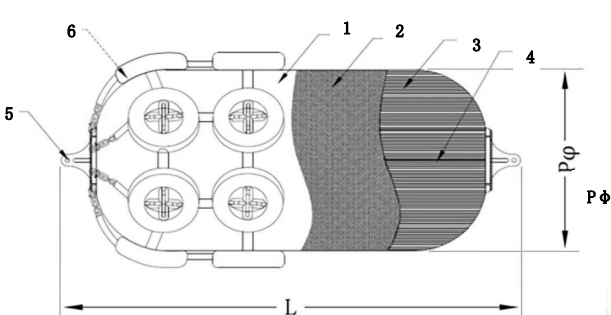
    It is cylindrical part of the air bag after being fully inflated with compressed air

    What is burst pressure?

    It is internal pressure at which the air bag bursts

    What is diameters of air bag?

    It is diameter of the air bag body

    What is head of air bag?

    It is conical parts connecting the body and the mouth of the air bag

    What is initial internal pressure?

    It is air pressure that fully inflates the air bag, before compression

    What is length of air bag?

    It is lenght of the air bag body

    What is mouth of air bag?

    It is metal valves mounted on both ends of the air bag for charging air

    What is percentage of deformation?

    It is ratio of the deformed height to the original diameter of the air bag while the air bag is being compresssed

    Ship Launching Marine AirbagsP= (D-H)/D

    Where

    P is the percentage deformation(%)

    is the original diameter of the air bag (%)

    H is the height of the compressed air bag (m)

    What is rated working pressure?

    It is maximum allowable internal pressure of the air bag while supporting a weight or load equal to the rated bearing capacity of the air bag

    What is Synthetic-tire-cord layers?

    It is reinforced layer of the air bag which is made of rubber coated synthetic-tire-cord fabrics

    What is total length of air bag?

    It is overall length of the air bag

    What is the type and model of air bags?

    Marine air bags are categorized by the following two types according to the bearing capacity, per meter in lenght:

    a) QP – ordinary air bag’

    b) QG – high-bearing capacity air bag

    What is the size of ship launching airbags?

    Diameters of air bag (d) varies such as 0.8m, 1.0m, 1.2m, 1.5m and 1.8m, etc.

    Length of air bag (L) is to be specified by the user.

    By Ronsen Marine News Uncategorized
  • 09 Jun

    What Is Foam Filled Marine Fenders?

    Foam Filled Fenders

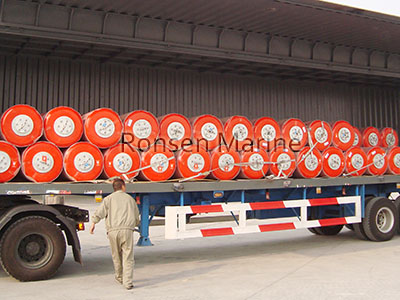
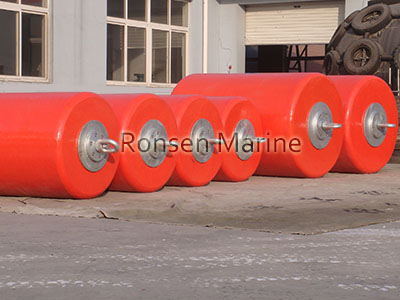
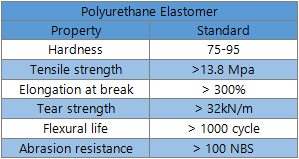
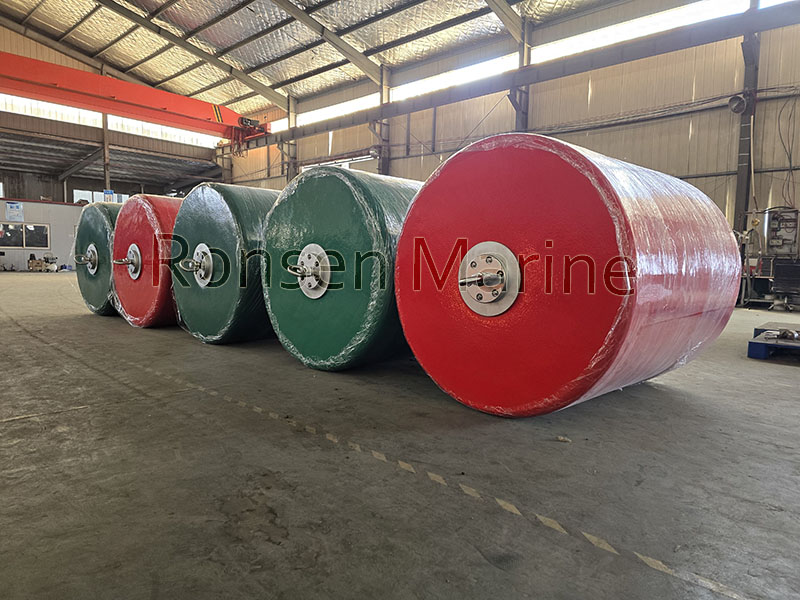
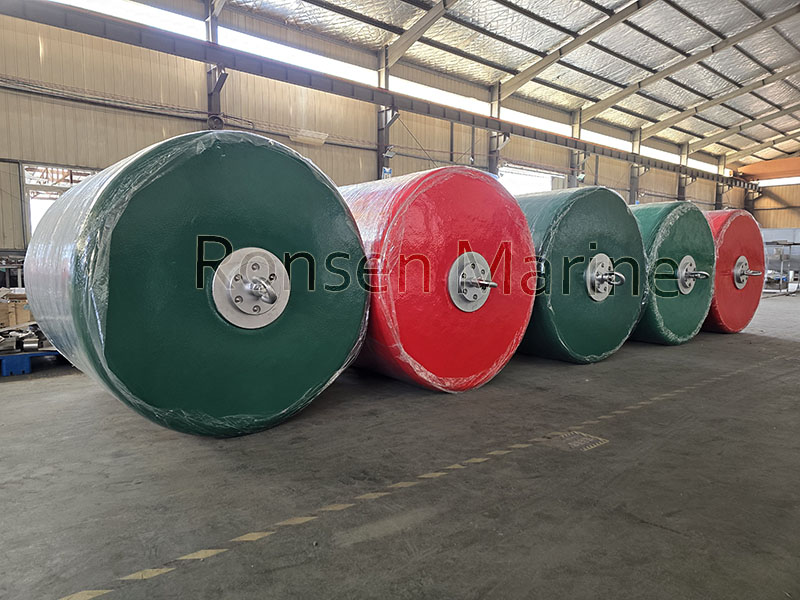
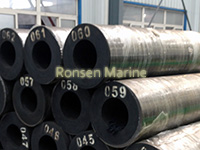
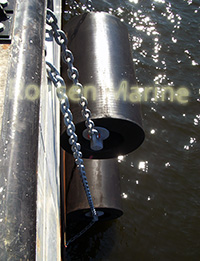
    Foam filled fender, also known as solid polyurethane fender, is a floating fender system made of foamed polyurethane, foamed EVA, or foamed rubber, primarily used for ship-to-berth protection in scenarios such as ports, docks, offshore oil platforms, and ship-to-ship operations. This product employs lightweight, high-elasticity foam as the cushioning medium, with closed-cell foamed material internally and polyurethane elastomer externally sprayed to enhance corrosion resistance. The fender has floating properties, allowing installation positions unrestricted by tidal fluctuations, and is secured via chain suspension. It exhibits significant reaction force variation at 60% compression with high energy absorption efficiency, a service life of 10-15 years, and features high strength, strong adhesion, maintenance-free operation, acid and alkali resistance, and anti-permeability. Product specifications range from 0.5 to 3.3 meters in diameter, with non-standard sizes available for customization, and exterior colors adjustable to meet identification requirements. Some models have received international certifications such as those from the China Classification Society and the French Classification Society.Foam Filled Fenders are versatile, robust and suitable for  almost all applications. The performance of foam filled fenders can be modified to meet the specific specification requirements, its manufacturing process allows for virtually any size of fender to be constructed selecting the appropriate grade of foam core and elastomeric skin.

    Foam Filled Fenders share a construction technology centered on a closed-cell polyurethane foam core and an outer skin of reinforced polyurethane elastomer. The closed-cell foam structure retains performance even if a fender’s skin is punctured. The closed-cell internal structure prevents water from ingressing into the foam.

    What is Foam Filled Fenders Construction & working principle?
    Foam Filled Fenders

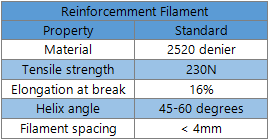
    The polyurethane floating fender is a compression-type fender, with a polyurea material serving as the outer protective layer and closed-cell rubber-plastic foam as the cushioning medium. Its interior features a closed-cell polyethylene foam core, and the fender surface is coated with polyurethane elastomer. The foam fender incorporates a spiral reinforcement layer (ZL201120207212.9), with the exterior made of polyurethane elastomer. Based on external assembly, it is categorized into sleeve-type, sleeveless-type, and rotating ear-type.
    R1: “Foam” must be translated as foam. Foam fenders can absorb impact energy through compressive deformation like a sponge [8]. By compressive deformation, they absorb the impact energy of vessels, thereby reducing damage to docks and ships [12]. When compressed by 60%, the reaction force increases significantly from small to large, and the energy absorption capacity is substantial.

    What is Foam Fenders Manufacturer Technology?

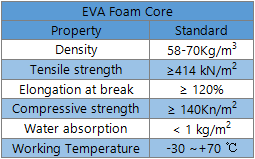
    The core of the solid polyurethane fender is made of EPU and a new type of polymer material with adjustable high elastic modulus. The internal buffer medium is high-density closed cell rubber plastic foaming material, such as polyethylene or EVA foam. Some products use 100% closed cell EVA foam hot lamination technology, which does not use adhesives. To enhance toughness and puncture resistance, some fenders use spiral wound embedded nylon tire cords or spiral reinforcement layers inside.
    The external protective layer is formed by spraying polyurethane or polyurea elastomer onto the surface using high-pressure airless spraying equipment. After manufacturing, the fender needs to undergo inspection and pressure testing to ensure compliance with relevant standards.

    What is Foam Filled Fenders Classification?

    The classification of foam fenders includes polyurethane foam fenders, floating fenders, etc. The interior of polyurethane foam fender is EVA elastic foam body. After adding cord layer in the middle, polyurethane polyurea is sprayed on the exterior to protect the middle core body. The outer protective layer of the floating rubber foam fender is a rubber layer, which is wrapped in the foam core to form a protective sleeve through high-temperature vulcanization.

    What is Foam Filled Marine Fenders Performance?

    The foam filled fender is made of closed-cell foam material, capable of absorbing 1.2-1.5 times the energy of an inflatable fender, effectively dissipating impact energy during compression. Its reaction force coefficient can be as low as 40-60 kN/m, approximately 30% lower than the traditional DA-type rubber fender’s 60-80 kN/m, helping to reduce hull stress and dock damage risks. The closed-cell foam structure evenly distributes stress under compression, preventing localized stress concentration.
    The outer surface of the fender is protected with a polyurethane elastomer layer, offering strong resistance to seawater corrosion and a service life of up to 15 years. The standard design lifespan is typically 10-15 years, while some products can last 15-30 years under suitable conditions. These products require no regular inflation checks, pose no risk of leakage, and demand minimal maintenance.
    The weight of the fender is reduced by 60%-70% compared to steel fenders of the same specifications, making it lighter and facilitating handling and installation. It possesses self-floating capability, allowing automatic position adjustment with tidal water levels, and installation is not restricted by tidal variations. As a solid structure, it eliminates the risk of explosion, and its external protective layer offers scratch and abrasion resistance.
    R1: “Foam” must be translated as foam. The polyurethane elastomer combines the high strength of plastics and the high elasticity of rubber, exhibiting properties such as wear resistance, oil resistance, acid and alkali resistance, and low-temperature resistance. The internal foam material can be recycled and reused, reducing waste generation.

    What is Foam Filled Fenders Advantages?

    1. It has floating performance and its installation position is not affected by tidal range
    2. No need for inspection during use, no need for inflation, not afraid of scratching, not afraid of friction, resistant to seawater, acid and alkali, with a service life of up to 10-15 years
    Year, maintenance free
    3. There is no danger of explosion and it is safe
    4. It has better energy absorption performance and lower reaction force performance. When compressed by 60%, the reaction force decreases from small to large and the energy absorption is extremely high.
    5. The product specifications are manufactured according to the needs, with the largest specification in ship fenders
    6. The exterior of the fender can be coated with various colors, making the product smooth and beautiful, with clear markings
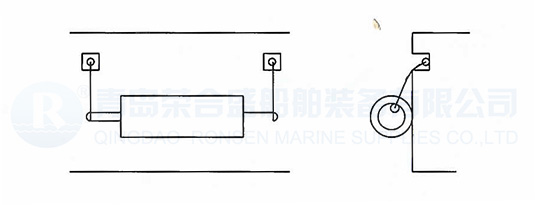
    7. Adopting chain suspension, easy installation and mobility, the chain tire mesh can be freely selected to increase the service life of the fender

    What is Foam Fenders Specification and Certification?

    The conventional standard size range for solid polyurethane fenders is diameter (D) 0.5 meters to 3.3 meters and length (L) 1.0 meters to 6.5 meters In addition, manufacturers can produce products of unconventional sizes according to customer needs.
    According to the external assembly method, solid polyurethane fenders are mainly divided into three types: sheathed, unsheathed, and rotating lifting ear.
    The products of mainstream manufacturers have passed quality certifications from multiple international classification societies, including China Classification Society (CCS), French Classification Society (BV), Det Norske Veritas (DNV), American Bureau of Shipping (ABS), etc.
    The product performance parameters include specifications (diameter and length), reaction force (tons) and energy absorption (tons · meters) at 60% compression deformation, and body weight (kilograms). The specific values cover a wide range, such as specifications ranging from a diameter of 300 millimeters and a length of 500 millimeters to a diameter of 3000 millimeters and a length of 6000 millimeters, corresponding to a reaction force of 1.5 tons to 160 tons when compressed by 60%, energy absorption ranging from 0.18 tons · m to 114 tons · m, and body weight ranging from 4 kilograms to 1988 kilograms. These parameters are measured based on a static state with a tolerance of ± 10%.

    What is Foam Filled Marine Fenders Features?
    • Wide range of standard and custom sizes
    • Low reaction and high energy options
    • Operate floating or suspended
    • No chain/tyre required
    • No-marking even against while hulls
    • Unsinkable design
    • Widely used in naval application
    • Since it is not air filled it is virtually maintenance free
    What are Foam Filled Fenders Application?
    • Cruise Ships
    • Container Vessels
    • Bulk Cargo
    • RoRo and Ferries
    • Oil and Gas Tankers
    • General Cargo
    • Navy Berths
    • Ship-to-ship transfers
    What is Foam Fender Effect of Temperature?

    Polyolefin foams are used in foam filled fenders. When subjected to high temperatures, these foams can lose some of their compression resistance, and therefore lose some energy absorption capacity. Likwise, when these foams are subjected to low temperatures, they become stiffer and gain energy capacity. This effect is temporary in both cases, if not carried to the extreme.

    The graph above shows the effect of temperature on the various types of foam used in foam fenders. The energy absorption is shown relative to the foam in a standard fender compressed at a rate of 2 in/min(51 mm/min) at 75 (24 degree), which is assigned a rating of 100. This does not reflect the performance of the fender as a whole, because other factors come into play in determining the energy absorption capacity, such as skin thickness and the confining effect of the skin on the foam.

    However, the general trend will be evident. In general, if a fender will be constantly exposed to elevated temperatures, such as in installations in hot climates, a slightly larger fender size than normal may be recommended.

    What is Foam Filled Marine Fenders Effect of Compression Speed?

    At a given percent compression, foam compressed at a high strain rate will absorb more energy than foam compressed at a low strain rate. Polyolefin foams compressed at high strain rates are stiffer than when compressed at low strain rates, where strain rate is defined as the fraction of the foam thickness compressed in a given time interval. This trend shows up in fender performance, although other factors come into play in determining fender energy absorption, such as skin thickness, temperature, and the confining effect of the skin on the foam.

    By Ronsen Marine Uncategorized
  • 04 Jun

    What Is a Floating Pneumatic Rubber Fender?

    Floating pneumatic rubber fenderFloating pneumatic rubber fender is fender which is made of synthetic-cord-reinforced rubber sheet with compressed air inside to enable it to float on the water and work as a shock absorber between to ships, or between ships and berthing structures when they come alongside each other on the water. This high pressure floating pneumatic rubber fenders have sometimes been colloquially referred to as “Yokohama fenders” or  “Yokohama type fenders”.

    What is Outer Rubber?

    It is rubber layer that covers the outside of the pneumatic fender to protect the cord layers and the inner liner rubber from abrasion and other external forces

    What is Inner Rubber?

    The liner of rubber membrane that seals the pressurized air inside the fender

    What is synthetic-tyre-cord layer for reinforcement

    Layer made of synthetic-tyre-cord fabric, which maintains the internal air pressure of the fender. As the main fibres of the synthetic-tyre-cord fabric are not braided like synthetic canvas fabric or synthetic belt fabric, there are advantages for its fatigue-resistanceperformance and pressure-holding performance.

    Where is the bead ring?

    Steel ring which is placed at one end (or both ends) of the fender and holds the end of cord layers

    Where is the flange opening?

    Steel flange, which is mounted on the pneumatic rubber fender, to which an air valve or safety valve can be adapted

    What is guaranteed energy absorption?

    It is energy that the floating pneumatic fenders can absorb without permanent deformation or failure

    What is reaction force?

    It is force produced by a fender reacting to a compressive force, the reactive force is equal to the force of the air pressure of the fender multiplied by the area of the fender in contact with the ship or berthing structure

    What is the initial internal pressure?

    It is air pressure at which can uncompressed fender operates

    What is endurable pressure?

    It is inner pressure at which a fender bursts

    What is net-type floating pneumatic fender?

    It is fender which is covered by a protection net consisting of either chain, wire or fibre  and usually with tyres or rubber sleeves.

    What is sling-type pneumatic rubber fender?

    It is a fender which is designed to be used without a protection net

    By Ronsen Marine News Uncategorized
1 2 3