
Quick Answer: What Is a Cone Rubber Fender?
A cone rubber fender is a high-performance marine fender with a conical shape that absorbs massive berthing impact energy while exerting low reaction force on both the vessel hull and the dock structure. Its unique truncated-cone geometry allows it to deflect up to 70% of its height, making it one of the most efficient fenders for large container ships, oil tankers, and LNG carriers at high-traffic ports.
How Does a Cone Rubber Fender Work?
When a vessel approaches a berth, the cone fender compresses axially and flexes radially. Its conical profile allows it to:
- Absorb high impact energy by deflecting up to ~70% of its height without a sharp rise in reaction force.
- Self-center under load, staying aligned even during oblique berthing angles (up to 10–15° off-axis).
- Distribute loads evenly when paired with a steel frontal panel and UHMW-PE facing pad, reducing hull pressure and preventing marks.
- Resist shear and torsion, making it ideal for locations with strong currents, tides, or frequent vessel movement.
Most cone fenders are single-piece moldings made from marine-grade, UV- and seawater-resistant rubber compounds, often installed with pre-built-in bolts, chains, and frontal panels.
Key Advantages of Cone Rubber Fenders
Compared with traditional arch or cylindrical fenders, cone fenders offer several performance benefits:
✅ Highest energy absorption per unit size – smaller cones can replace larger cell or arch fenders, lowering project cost.
✅ Low reaction force – gentler on both quay walls and ship hulls.
✅ Excellent shear resistance – stable under oblique impacts and tidal movement.
✅ Long service life – marine-grade rubber compounds resist UV, ozone, and salt corrosion.
✅ Low maintenance – robust one-piece molding with minimal moving parts.
✅ Flexible installation – can be mounted normally or reversed on narrow structures.
Typical Applications
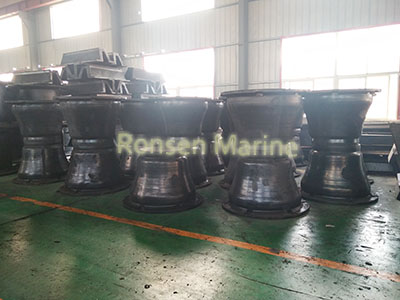
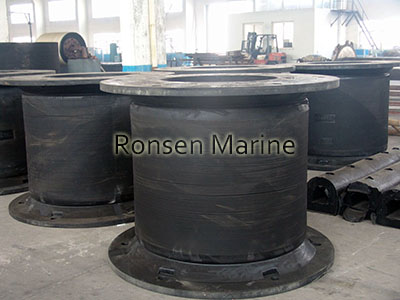 Cone rubber fenders are widely used in medium- to high-traffic terminals handling large vessels, including:
- Container terminals and general cargo wharves
- Oil, gas, and LNG berths
- RoRo (roll-on/roll-off) and cruise terminals
- Naval and offshore platform dolphins
- Ports with large tidal ranges or frequent berthing cycles
Cone Fender vs. Cell Fender: What’s the Difference?
FeatureCone Rubber FenderCell Rubber FenderEnergy absorptionHigher (up to 70% deflection)Moderate (~52.5% deflection)Reaction forceLower at same energy levelHigherShear resistanceExcellent (conical geometry)GoodFrontal panel compatibilityOptimized for large panelsCompatibleSpace requirementCompact footprintSimilar
Bottom line: If your priority is maximizing energy absorption while keeping reaction force low—especially with large panels or angled berthing—cone fenders are typically the better choice.
Common Cone Fender Sizes & Customization
Standard cone fenders range from roughly 300 mm to 1,500+ mm in height, with corresponding reaction-force and energy-absorption ratings tailored to specific berthing energies. Many suppliers offer:
- Custom heights and diameters
- Different rubber hardness grades (standard / intermediate / high-energy compounds)
- Custom colors and mounting hardware
- Pre-assembled kits with frontal panels, UHMW-PE pads, chains, and anchor bolts
Always specify your vessel size, berthing angle, tidal range, and design energy when requesting a quotation.
Maintenance, Inspection, and Longevity Practices
Routine Inspection Checklists for Marine Operators
Port authorities should establish a scheduled maintenance program to inspect their fendering assets at least once every six months. A standard inspection checklist should include:
- Checking the rubber cone body for deep cuts, ozone cracking, or permanent deformation.
- Inspecting all anchor bolts and chain shackles for signs of severe marine corrosion or loosening.
- Measuring the remaining thickness of the UHMW-PE face pads to ensure they have not worn down to the steel panel bolts.
- Verifying that weight support and tension chains maintain the correct amount of slack.
Troubleshooting Common Wear Issues (Friction, Shear, and UV Damage)
If an operator notices localized cracking near the base of the cone, it often indicates excessive shear stress caused by a broken tension chain. Accelerated wear on the UHMW-PE pads suggests high amounts of silt or rough hull surfaces scraping the berth. Replacing worn face pads early prevents metal-on-metal contact, preserving both the vessel hull and the internal steel frame from costly damage.
Estimating and Extending the Service Life of a Cone Fender
A premium, properly maintained cone fender system can easily achieve an operational lifespan exceeding 20 years. To maximize longevity, port operators should keep marine growth cleared from around the rubber base and ensure that chain assemblies remain properly adjusted. Investing in high-quality UV-stabilized rubber compounds during the initial procurement phase pays massive dividends by preventing premature environmental degradation.
FAQ: Cone Rubber Fenders
Q: What vessels are cone rubber fenders suitable for?
A: They’re commonly used for container ships, bulk carriers, oil/LNG tankers, cruise ships, and naval vessels at medium-to-largeQ: How long does a cone fender last?
A: With proper installation and occasional inspection, high-quality marine-grade cone fenders typically last 10–15+ years in harsh saltwater environments.
Q: Do cone fenders require a frontal panel?
A: While not strictly mandatory, most installations include a steel frontal panel with a UHMW-PE facing pad to spread hull pressure and reduce friction.
Q: Can cone fenders be used on narrow jetties?
A: Yes—cone fenders can be mounted in reverse (small face toward the quay) to fit structures with limited footprint.
Q: Are cone fenders compliant with international standards?
A: Reputable manufacturers produce cone fenders in accordance with standards such as PIANC Guidelines and ISO 17357.
Conclusion
A cone rubber fender is one of the most efficient, durable, and versatile solutions for protecting docks and vessels during berthing. Its conical geometry delivers industry-leading energy absorption with low reaction force, excellent shear resistance, and long-term reliability—making it a smart investment for modern port infrastructure.
Need a Quote or Technical Proposal?
If you’re planning a new terminal or upgrading an existing berth, our engineering team can help you select the right cone fender size, compound, and mounting system for your design energy and tidal conditions.
👉 Contact us today for a free technical proposal and customized quotation.

