
Support Buoys: The Complete Guide to Offshore Mooring Buoys
In offshore marine operations, reliability is everything. From Single Point Mooring (SPM) systems to subsea cable installations, support buoys provide the critical buoyancy needed to keep 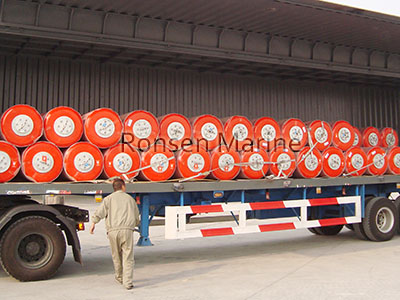 chains, hoses, and cables safely afloat. Choosing the wrong buoy can lead to equipment loss, downtime, and safety hazards.
This guide explains what support buoys are, how they are constructed, the main types available, and how to select the right one for your offshore project.
What Are Support Buoys?
Support buoys are heavy-duty floating devices designed to support and protect marine infrastructure—primarily mooring chains, ropes, and hoses. Unlike small navigational markers, offshore support buoys must withstand high tensile loads, continuous wave action, UV exposure, and corrosive seawater.
Modern foam-filled support buoys are virtually unsinkable, making them the preferred choice for mission-critical offshore applications.
Support Buoy Construction: Why Foam-Filled Wins
Premium marine support buoys, such as those manufactured by Ronsen Marine, use a three-layer closed-molding process:
1. Core: Closed-Cell EVA/PE Foam
The core consists of low-density polyethylene (PE) or Ethylene-Vinyl Acetate (EVA) foam. Its closed-cell structure ensures 100% watertight integrity—even if the outer skin is punctured, the buoy retains full buoyancy.
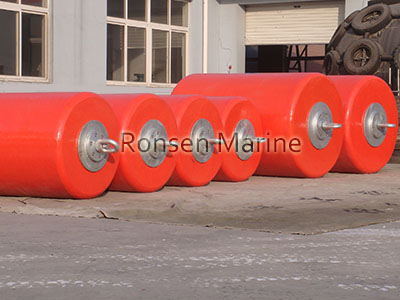 2. Reinforcement: Nylon Tire Cord Layers
Multiple layers of high-tenacity nylon tire cord fabric wrap the core, absorbing tensile stress from chains and preventing elongation under dynamic loads.
3. Outer Skin: Polyurethane Elastomer
The outer shell is a thick, seamless polyurethane (PU) elastomer coating that is:
- Abrasion-resistant – withstands friction from chains and hulls.
- UV-stable – prevents chalking and surface degradation.
- Non-marking – optional colored PU avoids hull staining.
Types of Support Buoys
Selecting the correct type depends on your specific offshore application:
A. Chain-Through Support Buoys (Cylindrical)
These buoys feature a steel central tube, allowing the mooring chain to pass directly through the buoy.
- Application: Used as chain-stopper buoys in SPM systems to support chain weight and reduce hawse-pipe tension.
- Advantage: Excellent load distribution and stability in strong currents.
B. Pick-Up Buoys (Cylindrical or Spherical)
Smaller, lightweight buoys attached to mooring lines via pick-up ropes or chain plates.
- Application: Retrieving submerged mooring lines, marking subsea assets, and providing auxiliary floatation.
- Advantage: Easy handling and rapid deployment.
C. Foam-Filled Support Buoys (General Purpose)
Versatile buoys used across dredging, offshore wind, and cable-lay operations.
- Application: Supporting suction hoses, marker buoys for turbines, and temporary mooring points.
- Advantage: Unsinkable design and minimal maintenance.
Key Applications of Offshore Support Buoys
- Oil & Gas (SPM Systems): Mid-line chain support and tension reduction.
- Subsea Cable Installation: Keeping power and fiber-optic cables afloat during lay operations.
- Offshore Wind Farms: Marking turbine locations and guiding SOVs.
- Dredging Operations: Supporting discharge pipes and suction hoses.
- Defense & Ports: Temporary moorings and security barriers.
How to Select the Right Support Buoy
Follow these steps to specify the correct buoy:
- Calculate Required Buoyancy: Determine the submerged weight of the chain/rope plus desired freeboard.
- Match Chain Size: Ensure the central tube diameter fits your chain (e.g., 64mm, 76mm, 84mm).
- Assess Environmental Conditions: Factor in tidal range, current velocity, and wave height.
- Confirm Compliance: Verify alignment with PIANC guidelines and OCIMF recommendations.
- Choose Materials: Specify hot-dip galvanized or epoxy-coated steelwork for maximum corrosion resistance.
Support Buoys vs. Marine Fenders: What’s the Difference?
Although both float, their roles differ significantly:
- Support Buoys: Provide flotation and tension relief for mooring lines and chains.
- Marine Fenders: Absorb kinetic energy during vessel berthing to protect hulls and structures.
For comprehensive protection, offshore projects often deploy both foam-filled support buoys and foam-filled marine fenders
Maintenance Tips for Long-Term Performance
- Inspect PU skins annually for deep cuts or abrasions.
- Rinse buoys with fresh water after deployment in polluted or tropical waters.
- Check galvanized steelwork for signs of corrosion every 12 months.
- Store spare buoys in shaded, ventilated areas when not in use.
Frequently Asked Questions (FAQ)
Q: How long do foam-filled support buoys last?
A: With proper inspection and care, high-quality foam-filled support buoys typically deliver 10–15 years of service life, thanks to UV-stable polyurethane skins.
Q: Are support buoys truly unsinkable?
A: Yes—when constructed with closed-cell EVA/PE foam cores. Unlike air-filled buoys, foam cores displace water permanently and remain afloat even after major skin damage.
Q: Can support buoys be customized?
A: Absolutely. Ronsen Marine offers customization in diameter, length, color (yellow, orange, red, green), and hardware (galvanized vs. stainless steel).
Conclusion
Investing in the right support buoys enhances safety, reduces downtime, and lowers lifecycle costs. Foam-filled, polyurethane-skinned buoys deliver unmatched reliability in the harshest offshore environments.
Need support buoys for your next offshore project?
Ronsen Marine supplies ISO-certified foam-filled support buoys worldwide. Contact our engineering team</a > today for technical drawings and a competitive quotation.
Related Resources:
Cylindrical Chain Support Foam Buoys
Foam Filled Fenders
What Is a Foam Filled Fender?

