
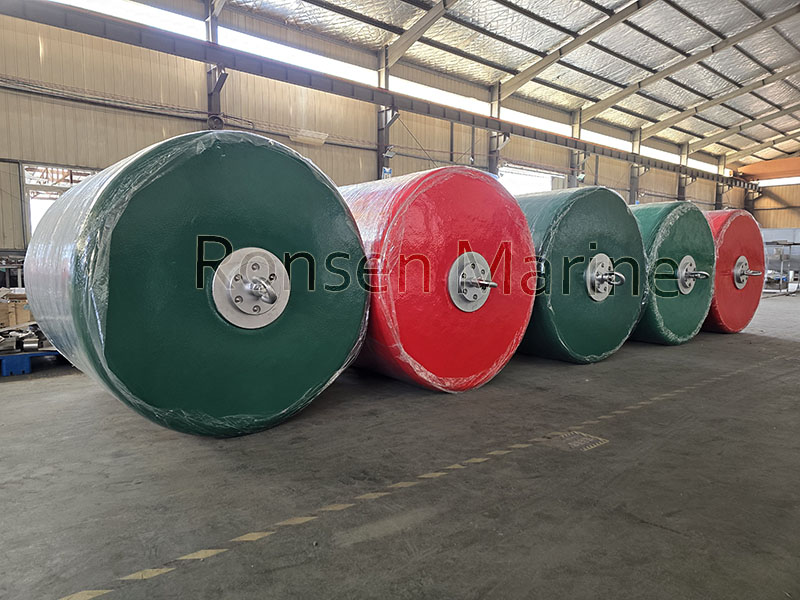
To choose between a chain-through, cylindrical, and pick-up offshore mooring support buoy, start from the load path: if the mooring chain must pass axially through the float and share tension, specify a chain-through buoy (CTB); if the chain or hose attaches to end fittings and the buoy only lifts a span, use a cylindrical foam buoy (CUB); if you only need to mark and retrieve a submerged line end, a pick-up buoy (PUB) is enough. Size every option by net buoyancy, not gross diameter, and set SWL from the steelwork, not the foam.
This guide gives offshore engineers and procurement a repeatable way to pick the right type, calculate buoyancy, and avoid the spec mistakes that sink SPM and cable-lay jobs.
Support Buoy Basics Before You Compare Types
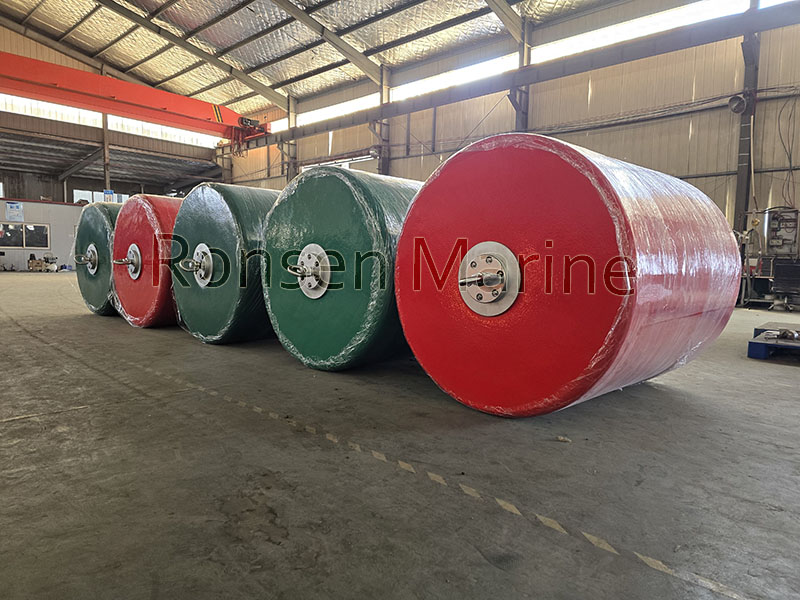
A foam-filled offshore support buoy is a closed-cell PE/EVA foam core + central steel strength member + PU/polyurea skin. The foam gives permanent displacement; the steel tube, gussets and flanges take tension; the skin resists abrasion, UV and seawater. Puncture the skin and the closed cells still float—unlike air-chambered or steel hollow buoys.
Three facts that decide type selection:
- Foam never carries tensile load. SWL comes from the central tube and end fitting cert.
- Net buoyancy ≠ gross buoyancy. You must subtract the buoy’s own weight in water.
- Type follows geometry of the line. Axial chain-through = CTB. End-to-end pendant = CUB. Messenger/retrieval = PUB.
Chain-Through vs Cylindrical vs Pick-Up: Side-by-Side
[supsystic-tables id=18]
Sources: typical CTB/CUB/PUB spec sheets list 1.5–4.5 t CTB, 1–4 t CUB, 90 kg–1 t PUB classes.
Step 1 — Define What the Buoy Must Lift
List the submerged element:
- Mooring chain diameter & grade (e.g. 76 mm studlink, Grade 3)
- Hose OD + fill (oil-filled hose ≈ 3× empty submerged weight)
- Subsea cable or umbilical wet weight per metre
- Rope/pendant submerged weight
Only the segment the buoy suspends counts, not total scope.
Step 2 — Calculate Net Buoyancy (Not Gross)
B_net = ρ_sw · g · V_displaced − W_buoy Required: B_net ≥ W_submerged_line + F_freeboard_reserve
- ρ_sw ≈ 1025 kg/m³
- W_submerged_line = length × (air weight − buoyancy of that line)
- F_freeboard_reserve = 30–50 % of B_net, to cover tide, current drag, marine growth, bird/rope load
Working rule: load the buoy to 50–60 % of net buoyancy; keep the rest as reserve. A 76 mm chain span of ~20 m submerged weighs ~2.4 t; with hose patch + freeboard reserve, specify a CTB-3500 (3.5 t net), not a 2.5 t class.
Step 3 — Match Type to Load Path
- Chain passes through and must stay centred under tension → CTB with central tube ID cleared for your chain + locking plate/pin.
- Load is end-to-end (hose float, dredge pipe, cable lay float) → CUB with swivel/pad-eye/clevis ends.
- You only need to find and pull up a buried mooring tail → PUB 90 kg–1 t, often with pick-up rope eye.
Do not specify a PUB for SPM midline. Do not specify a CTB when the chain runs alongside a hose—CUB handles it cheaper.
Step 4 — Set SWL from Steelwork
SWL = 1/4–1/5 of steel assembly MBL (tube + flanges + shackle/swivel). Foam diameter does not set SWL. For a 76 mm chain SPM, typical CTB swivel SWL is 10–15 t class with 3.5 t net buoyancy—because the buoy lifts weight but the steel sees dynamic slack-load spikes.
Step 5 — Environment Inputs That Change the Class
- Tidal range > 4 m → bigger freeboard reserve
- Current > 2 kn → treat drag as extra downward static load
- Hs > 2 m → thicker PU (5–10 mm), nylon-reinforced skin option
- Ice / tandem berthing → nylon-filament PU, larger diameter
- Tropical fouling → 10-year PU, plan freshwater rinse
Step 6 — Material Spec Checklist
- Core: cross-linked closed-cell PE or EVA, thermo-laminated on mandrel
- Steel: ST52 central tube, gussets, load flanges, HDG or epoxy
- Skin: 3–10 mm PU elastomer, optional nylon-reinforced
- End fittings: swivel, pad-eye, clevis, crucifix, chain locking plate/pin; WLL cert per item
- Markings: owner tag, net buoyancy, SWL, chain size, year, color per terminal HSE
Decision Shortcut
- SPM terminal, chain is the lifted element → CTB
- Hose/cable/dredge pipe span, end fittings → CUB
- Marking, retrieval, messenger line → PUB
- Mixed hose + chain alongside → CUB for hose, CTB for chain, never one buoy doing both jobs
Common Sizing Mistakes
- Using gross buoyancy in the datasheet instead of net buoyancy
- Loading buoy to 85 % of net lift “because static calc allows it” → zero freeboard in swell
- Matching tube to chain diameter but not to shackle OD through the tube
- Setting SWL from foam diameter
- Forgetting oil-filled hose submerged weight
FAQ
Q: Can a cylindrical buoy replace a chain-through buoy in SPM?
A: Only if the chain does not pass through the buoy and attaches externally to end fittings rated for the load. In most SPM mid-line designs the chain is axial, so CTB is required.
Q: How much net buoyancy for a 76 mm chain SPM mid-line?
A: After catenary calculation, 2.5–4.5 t class CTB per station is typical; never size on chain weight alone—add freeboard reserve.
Q: Is a pick-up buoy a support buoy?
A: Technically yes, but it is a light-duty subtype (90 kg–1 t) for line-end retrieval and marking, not for suspending mooring chain load.
Q: Foam-filled or steel air-can buoy?
A: Foam-filled. Air chambers burst; closed-cell PE/EVA stays unsinkable after skin puncture.

