
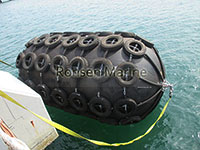
ISO 17357 pneumatic fender sizes are the nominal diameter × length combinations (in mm) defined for floating pneumatic rubber fenders under ISO 17357-1:2014 (high-pressure 50 kPa / 80 kPa grades) and ISO 17357-2:2014 (low-pressure ≤7 kPa grade). The most common catalogue range is Ø500 × L1000 mm up to Ø4500 × L12000 mm, with performance rated at 60 ± 5 % deflection.
A size like “3300 × 6500” means a fender 3.3 m in diameter and 6.5 m long—not a cube, not an inner-air volume. Diameter drives hull contact area and reaction force; length drives total energy absorption.
ISO 17357-1:2014 Standard Nominal Sizes (High-Pressure P50 / P80)
All values below are minimum guaranteed energy absorption (GEA) and reaction force (R) at 60 % deflection, taken from the standard supplier performance table. Tolerance on GEA/R is ±10 %.
[supsystic-tables id=17]
Non-standard intermediate sizes (600×1000, 700×1500, 1200×2000, 1350×2500, 1700×3000, 3000×5000/6000, 3500×6000/7000, 3600×7200) are also manufactured and certified to the same deflection basis.
ISO 17357-2:2014 Low-Pressure Sizes (≤7 kPa)
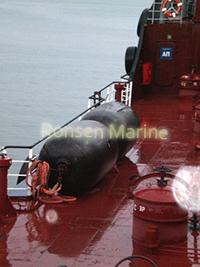
Part 2 covers a separate low-pressure product class:
- Clamped-end type: diameter ≤ 2.3 m
- Moulded-end type: diameter ≥ 2.8 m
- Initial pressure 7 kPa unless otherwise agreed
- Same GEA-at-60 %-deflection principle, but different body construction and test regime (leakage, compression recovery >97 %, 3000-cycle durability)
Buyers often confuse “ISO 17357 fender” with “Yokohama fender.” Yokohama is a brand origin; ISO 17357-1 compliance is the spec that matters on a purchase order.
P50 vs P80: Same Size, Different Performance
For the same diameter and length, an 80 kPa fender absorbs ~35–40 % more energy but pushes harder on the hull.
- P50 (50 kPa): lower reaction force, lower hull-surface pressure → LNG, aluminium hulls, yachts, navy, sensitive coatings.
- P80 (80 kPa): higher GEA per fender → large tonnage, high approach velocity, limited fender count.
- Never inflate a P50 body to 80 kPa. Cord-layer safety factor and end-ring design differ between grades.
Example: 3300 × 6500 mm
- P50: 1814 kJ / 3015 kN
- P80: 2532 kJ / 3961 kN
That is why “size alone” never specifies a fender—you must state ISO part + type + initial pressure.
Dimensional Tolerances & Marking (ISO 17357-1)
- Diameter tolerance: +10 % / −5 %
- Length tolerance: +10 % / −5 %
- Measured at rated initial pressure, mid-body average of ≥2 points
- Mandatory marking on body: ISO 17357 part, nominal size, initial pressure (50/80 kPa), serial no., maker, year
- Safety relief valve required at Ø ≥ 2500 mm (optional below if ordered)
Net Type vs Sling Type (Does Not Change Size Table)
ISO 17357-1 defines types by external protection, not by size:
- Type I – Net type: chain-tire net, wire net, or rope net (most common Ø1000 mm+)
- Type I Single: net on one end, metal-free other end
- Type II – Sling type: heavy nylon slings, no hard net, gentler on hull paint (preferred for LNG/yacht)
The GEA/R numbers in the size table apply to the rubber body; net/sling only changes abrasion protection and handling.
How to Choose the Right ISO 17357 Size
- Calculate design berthing energy (PIANC method: displacement × velocity² × coefficient).
- Pick a size whose P50 or P80 GEA ≥ design energy × safety margin (usually 1.1–1.25×).
- Check reaction force R against wharf foundation and hull-panel allowance.
- Check hull pressure reference value (122–208 kPa in table) against vessel shell limit.
- Confirm Ø ≥ 2500 mm → safety valve included.
- Choose net vs sling by hull finish and quay roughness.
Rule of thumb:
- Tug / pilot: 500×1000 to 1000×2000
- Feeder / ro-ro: 1500×3000 to 2000×3500
- Panamax / Aframax: 2500×4000 to 2500×5500
- VLCC / LNG / STS: 3300×6500, 3300×10600, 4500×9000
FAQ (add FAQPage schema for rich snippet)
Q: What is the largest standard ISO 17357 pneumatic fender size?
A: Ø4500 × L12000 mm is the largest commonly catalogued high-pressure size; 4500×9000 is also standard. Larger bespoke units are made but need prototype classification approval.
Q: Are ISO 17357 fender sizes in inches or mm?
A: Always millimetres in the standard (e.g., 3300×6500 mm). Suppliers may quote imperial equivalents but PO must use mm.
Q: Does longer length always mean more energy absorption?
A: For the same diameter, yes—roughly linearly. But reaction force rises with diameter faster than length, so 2500×5500 absorbs more than 2000×3500 despite smaller Ø? No: 2500×5500 (P50 943 kJ) > 2000×3500 (308 kJ). Diameter dominates R; length dominates GEA.
Q: Can I order a non-standard size like 3600×7200?
A: Yes. Custom sizes inside the 500–4500 mm Ø and 1000–12000 mm L envelope are produced, but they require the manufacturer’s certified prototype test, not a straight interpolation of the table.
Q: Is ISO 17357-1:2014 still current?
A: Yes—published 2014, confirmed in 2024. ISO 17357-2:2014 remains the low-pressure companion standard.

