
What Is an Arch Rubber Fender? The Practical Engineer Guide (2026)
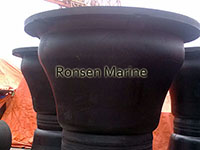
An arch rubber fender is a solid, arched-cross-section marine fender mounted on quays, pile dolphins, lock walls, or vessel hulls to absorb berthing energy and lower reaction force during docking. Its curved profile spreads impact across a wider face than a flat D-fender, yet stays simpler and cheaper than a cone or cell unit—making it the default choice for fishing harbors, ferry terminals, workboat jetties, and retrofit projects under roughly 10,000–50,000 DWT.
This guide explains what it is, how it absorbs energy, where it beats (or loses to) cone and cell fenders, and how to size one using PIANC / ISO 17357 logic.
What Is an Arch Rubber Fender (Definition)
An arch rubber fender is a single-piece molded solid rubber element with an inverted-U or arch cross-section. It is bolted to a steel mounting plate, often with a UHMW-PE front face panel to cut hull friction.
Core parts:
- Rubber body – natural rubber (NR) / SBR blend, 60%+ NR content for 15–20 yr life
- Steel base plate – anchors to concrete or steel quay
- Optional UHMW-PE pad – low-friction contact face
- Bolts / shear chains – resist pull-out and lateral shear
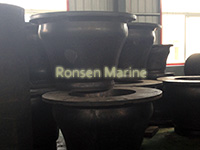
Unlike pneumatic or foam fenders, it has no air, no bladder, no moving parts—just elastic deformation.
How an Arch Rubber Fender Works
When a vessel touches the berth:
- The arch cross-section compresses vertically, converting kinetic energy into heat inside the rubber.
- The curved legs spread reaction force sideways, avoiding stress concentration on the quay face.
- At rated deflection (usually 50–60% of free height), it returns most of its shape—no permanent set if within design load.
- UHMW-PE face lets the hull slide instead of gripping, reducing berthing shear.
Typical solid-rubber arch performance band:
- Energy absorption: 15–80 kJ per unit (small–medium berths)
- Reaction force: moderate, higher than cone, lower than cylindrical
- Hull pressure: low–moderate
- Service life: 10–20 years with 6-month visual checks
Arch Fender vs Cone vs Cell (Quick Table)
[supsystic-tables id=10]
Arch wins on price + simplicity; loses on energy density per kg.
Where Arch Rubber Fenders Are Used
- Fishing ports and small craft harbors
- Ferry terminals and Ro-Ro side berths
- Workboat / pilot boat jetties
- Lock chamber walls and corner dolphins
- Retrofit of old quay walls with low allowable reaction
- Inland barge terminals
They are not for 100k+ DWT tankers or high-velocity VLCC berths—use cone or cell there.
How to Size an Arch Fender (PIANC Logic, Simplified)
You do not guess size from a photo. Use the standard berthing energy formula:
E = 0.5 × Cm × M × Vb² × Ce × Cc × Cs
Where:
- Cm = added mass factor (1.3–2.0)
- M = vessel displacement (tonnes)
- Vb = normal berthing velocity (m/s)
- Ce / Cc / Cs = eccentricity, configuration, softness factors
Then:
- Calculate design energy E (kN·m)
- Pick arch unit whose catalog energy at 50% deflection ≥ E
- Check reaction force R ≤ quay allowable
- Check hull pressure ≤ class approval (usually < 200 kPa for small craft)
- Space units at ≤ 12–15 m or 0.15 × vessel length
💡 Most specifiers oversize by 20–30% for tidal skew and operator error.
Installation & Maintenance Basics
Install:
- Mount above low-tide line for inspection
- Torque bolts 100–200 Nm, re-check after 3 months
- Horizontal on straight walls, vertical on piles, angled at corners
- Add shear chain if tidal range > 3 m
Maintain:
- Visual check every 6 months (cracks, abrasion, bolt rust)
- Clean salt/debris quarterly
- Re-coat steel parts per ISO 12944 every 2–5 yrs
- Replace if deflection recovery drops below 50% of rating
Arch Rubber Fender FAQ
Is an arch fender the same as a D-fender?
No. Arch has a taller curved leg profile and better energy-per-kilo; D-fender is a flattened D-shape for light craft and narrow edges.
What rubber quality should I specify?
Minimum PIANC G3-type compound: tensile ≥15 MPa, elongation ≥350%, hardness 60±5 Shore A, compression set ≤25% after 70°C×22h.
Can arch fenders handle angled berthing?
They tolerate small skew (≤5°) acceptably. For 10°+ angular hits, cone fenders are better.
How long do they last?
10–15 yrs in high-traffic fishing ports, 15–20 yrs in moderate ferry use, if virgin NR blend and not overloaded.

