
Ship Launching Airbags: How to Select the Right Marine Rubber Airbag for Safe Vessel Launching
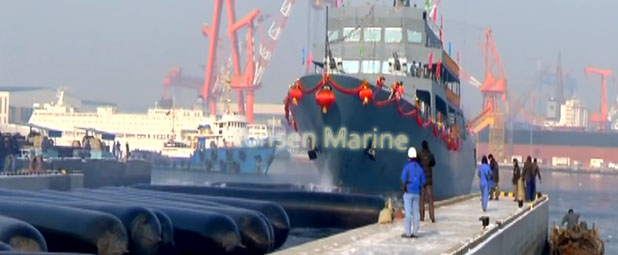
Marine rubber airbags—also called ship launching airbags, pneumatic rollers, or inflatable marine airbags—have replaced traditional slipways in hundreds of shipyards worldwide. They roll heavy vessels from build site to water with lower cost, faster setup, and no permanent civil works.
But choosing the wrong airbag specification leads to dangerous failures: burst bags, hull damage, or launch abort. This guide gives you the engineering basics, sizing formulas, and procurement checklist to get it right the first time.
What Are Ship Launching Airbags?
A ship launching airbag is a cylindrical, reinforced rubber tube inflated with compressed air to support and move a vessel. The body consists of:
- Inner rubber layer – seals air, resists seawater and abrasion
- Synthetic tire-cord layer(s) – nylon 6 or polyester, 1400dtex/3, providing tensile strength
- Outer rubber layer – protects against abrasion, UV, and impact during rolling
Standard sizes range from 0.8 m to 2.5 m in diameter and 6 m to 26 m in effective length. Working pressure typically sits at 0.08–0.12 MPa, with a safety factor of ≥3:1 per ISO 14409.
Note: “Marine rubber airbag” and “pneumatic roller” are interchangeable terms in most specifications. When sourcing, confirm the supplier uses the exact terminology matching your classification society’s requirements.
How Airbag Launching Works
The process follows a predictable sequence:
- Block removal – wooden or steel support blocks under the hull are removed, leaving the vessel resting on deflated airbags.
- Inflation – compressors fill airbags to target pressure (monitored by calibrated gauges).
- Rolling – the vessel moves down the inclined way as airbags deform and rotate beneath the hull.
- Water entry – the hull floats free; airbags are recovered, deflated, and stored for reuse.
A single set of airbags can launch vessels from tens of tons to over 10,000 tons, depending on specification and quantity.
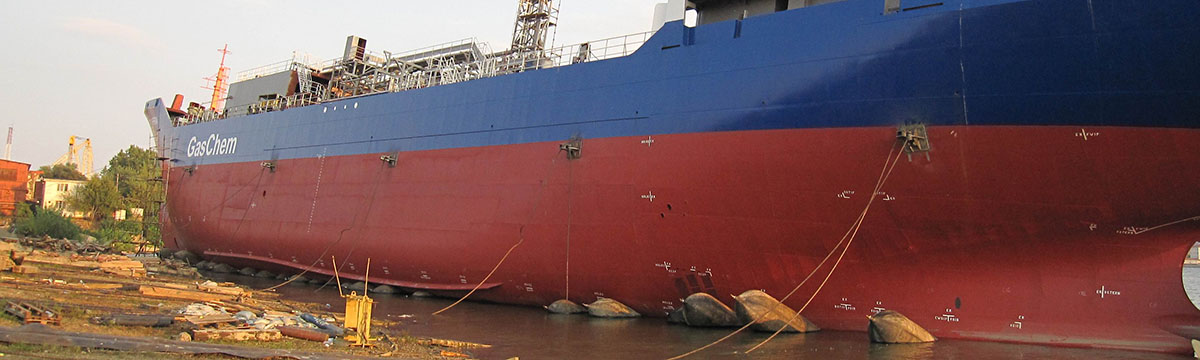
Key Specifications Buyers Should Verify
Diameter and Effective Length
[supsystic-tables id=19]
Cord Layers (Ply Rating)
Cord layers determine burst pressure. Common configurations:
- 4–5 layers – light duty, small craft
- 6–8 layers – standard commercial launching
- 10–12 layers – heavy vessels, high safety margin
Each synthetic tire-cord layer (nylon 6, 1400dtex/3) provides a minimum breaking strength of ≥310 N per cord. Total burst pressure scales with layer count.
Working Pressure and Safety Factor
Per ISO 14409, minimum safety factor is 3:1 (burst pressure ÷ working pressure). For a 0.10 MPa working pressure, the bag must withstand ≥0.30 MPa in hydrostatic burst test.
How to Calculate Airbag Quantity for Your Vessel
Use this simplified engineering approach:
Step 1 – Determine total hull weight (lightship + outfitting margin + water trapped in hull)
Step 2 – Estimate contact area
Contact width ≈ Diameter × 0.6 (empirical deformation factor) Contact length ≈ sum of effective lengths of all airbags Total contact area = Contact width × Contact length
Step 3 – Calculate required airbag count
Single airbag load capacity = Working pressure × Contact width × Effective length × Safety derating (0.7–0.8) Required count = Total vessel weight ÷ Single airbag load capacity
Example – 500-ton barge, 1.5 m diameter, 12 m effective length, 0.10 MPa working pressure:
- Contact width ≈ 0.9 m
- Single bag capacity ≈ 0.10 MPa × 0.9 m × 12 m × 0.75 ≈ 81 kN ≈ 8.3 tons
- Required count ≈ 500 ÷ 8.3 ≈ 60 airbags (distribute along keel and bilge)
Pro tip: Always add 15–20% buffer above calculated count. Slope irregularities, uneven inflation, and tidal timing all introduce variables you can’t fully control on launch day.
ISO 14409 vs CB/T 3795: What Certificates Importers Should Ask For
[supsystic-tables id=20]
When importing, request:
- Mill test certificate for rubber compound
- Hydrostatic burst test report (video evidence preferred)
- Third-party inspection (CCS, BV, ABS, or DNV) if required by your flag state
- Traceability code on each airbag body
Ship Launching Airbags vs Concrete Slipway: Cost & Site Comparison
[supsystic-tables id=21]
For shipyards launching under 5,000 tons, airbags typically deliver 60–80% cost savings over building a slipway.
Common Failure Modes and How to Avoid Them
[supsystic-tables id=22]
Pre-Launch Inspection Checklist
[ ] Visual inspection – no cuts >50 mm, no cord exposure
[ ] Pressure hold test – inflate to 1.1× WP, hold 30 min, pressure drop <5%
[ ] Relief valve calibrated and installed
[ ] Pressure gauges certified within 12 months
[ ] Slope gradient verified by surveyor
[ ] Tide and wind forecast checked (launch window)
[ ] Recovery boat and crew on standby
[ ] Emergency stop procedure briefed to all personnel
FAQ
How many times can a ship launching airbag be reused?
With proper storage and operation, 80–200 cycles. Inspect after every 10 launches; replace if cord layers show through outer rubber or burst pressure degrades below 2.5× WP.
Can airbags launch a vessel on a sandy or muddy beach?
Yes, but the slope must be graded and compacted. Loose sand increases rolling resistance and can abrade the outer rubber. Lay geotextile or steel plates if ground is soft.
What is the minimum water depth required for airbag launching?
Rule of thumb: water depth at the launch point should be ≥1.5× vessel draft + 0.5 m safety margin. Check local tidal range and launch at high tide if possible.
Do I need classification society approval for airbag launching?
For commercial vessels, most flag states require the launching procedure to be reviewed by a classification society (CCS, BV, ABS, DNV, etc.). The airbags themselves should carry ISO 14409 compliance documentation.
What compressor capacity is needed?
Total air volume = number of airbags × internal volume per airbag. A 1.5 m × 12 m airbag holds ~21 m³. For 60 bags, you need ~1,260 m³. Size compressors to fill all bags within 2–3 hours. Typical setup: 2–3 units at 10–15 m³/min each.
About [Qingdao Ronsen Marine Supplies Co.,Ltd]
[Qingdao Ronsen Marine Supplies Co.,Ltd] has supplied marine rubber airbags to shipyards in [regions/countries] since [year]. Our airbags are manufactured to ISO 14409 standards with nylon 6 cord layers, hydrostatic burst tested, and certified by [CCS/BV/ABS]. We provide technical calculation support and on-site supervision for vessel launching projects.
Need a custom airbag specification for your vessel? Contact our engineering team at [sales@ronsen-marine.com/+86 183 5328 0885] or request a quote through our [Ship Launching Airbags].
[Marine Rubber Airbags] – “View our full range of ISO 14409 marine rubber airbags”
[Rubber Fenders] – “Related: marine fender systems for dock protection”
[Contact/Quote page] – “Get a free airbag quantity calculation for your vessel”

